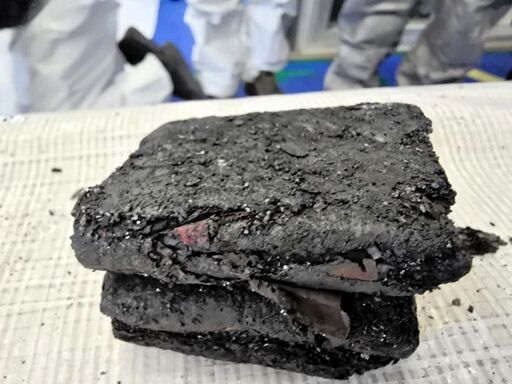
The new rule will limit passengers to a total of two spare batteries, including power banks.
While there is no limit on the number of spare batteries below 100 watt-hours, carrying power banks exceeding 160 watt-hours will remain prohibited.
Power banks will be capped at two units regardless of power capacity.
Do you need to be intellectually challenged to understand this?
Political class whore: “Should we regulate the corporations producing these faulty batteries?”
Corporate Lobbyist: “nah, let’s just ban consumers from using them when they need them the most”
Political class whore: “yes, master”
It’s almost like the whole issue is that airports involve passengers crossing borders where the laws are different.
They’re doing that too:
The concern driving this ban is primarily centered around defective units already in circulation, and the acceptance that they cannot realistically be certain about their ability to prevent manufacturers in other countries from shipping in more potentially defective units. Most modern airplanes I have seen have in-seat USB charging ports, which at least cuts down on the need some, and a few hours without a charged device is not going to end the lives of anyone traveling (especially since this rule has carve outs for medical devices, I’m told).
Most modern airplanes I have seen have in-seat USB charging ports
You probably shouldn’t trust those to actually work. Or even to be safe enough to not kill whatever you plug into them.
Yeah, aircrafts are famous for being unsafe and allowing high voltage connectors exposed to passangers.
Also you shouldn’t plug your phone into random USB ports, although i guess carrying a charge pass through adapter is an option.
Just use your regular charger, there are typically outlets under the seat in front of you on B737/A320 and larger. Even many regional jets have them these days. I never plug into a random USB port.
And they’re so loose that’s it’s a miracle if your charger stays in. Maybe if there were updates and changes to prevent this I would understand but as someone who’s working 99% of the time while traveling, it’s a surprise when the ports work and I rely on battery banks heavily
If you’re that worried about it (and don’t have at least a passthrough charging cable), you can just turn your devices off and bring a book. I don’t know why you’d be worried about it killing your devices though, if a plane’s electrical system has failed so badly it’s going to fry things on the USB bus then you’ve got much bigger problems.
Damaged ports with shorted pins, voltage fluctuations, etc.
The passenger electrical system is as isolated from the the rest of the plane as possible, but if the entire thing fails, sure then yeah you’re fucked and have bigger problems
A USB transceiver is required to withstand a continuous short circuit of D+ and/or D- to VBUS, GND, other data line, or the cable shield at the connector, for a minimum of 24 hours without degradation
Shorts aren’t really a concern with decent hardware, but as far as I can tell that’s the problem with the power banks that are failing - they’re not decent hardware, so minor damage attached to a very energetic bag o’ chemistry results in (very occasional) fiery disaster.
Is that for USB A and USB C? USB PD could be riskier if it shorts VBUS to D+ or D- since it can negotiate up to 12 volts, IIRC
As I understand it it’s been the standard since 2.0 and continues to be the case, even for high-power systems. From personal experience of trying to make a USB-C USB killer for PD, it’s also just damned difficult to do. USB is an extremely resilient standard.
The negotiation needs to happen first - a compliant host port cannot just send 12V. Heck, even 5V at 5A depending on available power, the limit for PD, cannot just happen. A compliant USB-PD power supply is not supposed to deliver any power until an actual negotiation, or specific pull-down resistors on the device CC1/2 are detected.
Of course not all USB-C ports are compliant. USB-A is essentially a hardwired 5V at (your-guess-is-as-good-as-mine-the-spec-is-nonsense)A, and some transit systems like buses I have found and tested to just hardwire USB-C to provide 5V with no negotiation either. Maybe those had host-side resistors advertising any particular amperage (you can draw up to 3A at 5V ONLY depending on CC1/2 pull-up resistors with no further negotiation), but I wouldn’t count on it.
Also, you can’t really directly short VBUS to D+/-, since there are CC/SBU pins inbetween. On the host side, CC is either pulled up to VBUS (with a huge resistor) or tied to some IC, that might be able to detect bad conditions (though I have no experience here). On the device side, CC is either pulled-down with another big resistor, or tied to another IC. There are opportunities to detect errors and go into protection states, but that might not be the case depending on the ICs they’re using. SBU is supposed to be left floating or unconnected at the start.
Shockingly, when I travel abroad I’m usually out and about for the most days. And that’s where power bank is needed.
If can’t have them in my checked luggage and and I can’t have them in my carry on, am I expected to buy a power bank every time I fly and then throw it away?
On the topic of in-seat charging ports: your luck may wary. Even if you do find a plane which has these and they actually work, the power is not usually enough to charge more power hungry devices - bigger phones, tablets, steam deck. Don’t get me started of you actually want to use your laptop during the flight.
Yes, if you fly business there are usually power sockets which you can use, but who has money for that?
As much as it would be convenient, a plane simply does not have the electrical capacity to supply all passengers with high wattage USB outlets. Large numbers of high-capacity of lithium batteries are a solution, but are also a risk and given the recent number of fires caused by faulty Lithium battery packs, it’s unfortunate but reasonable for carriers to move to restrict them for the sake of passenger safety.
What flights are you on that you need a powerbank? Any decently modern phone will last for 24h on flight mode playing video. I’ve done 12-13h flights (Germany to Singapore) with 60% of battery remaining.
What flights are you on that you need a powerbank?
As @[email protected] said in another post, it’s not necessarily just about the time on the flight, but when you might need them after. Later this year, for example, I’m planning on heading to Europe and will attend a music festival while I’m there. I’ll be out all day, and would like to be able to use my phone to stay in touch with my travelling buddies, take pictures, maybe get a cab back to the hotel, or whatever else. It would be pretty nice to have a powerbank to keep my phone charged then, as well as for other days where I’m planning on being out sightseeing all day. If you’re already forbidden from storing them in your checked bag, and now you’ll be banned from bringing them in your carry-on, what exactly are you meant to do, then? Buy a new powerbank every time you travel? Just for my trip and travel group, we’d need to purchase and discard 4 of them on this trip, as we’ll be staying a few days in one country for sightseeing before hopping on a plane to the opposite corner of Europe for the remainder of the vacation. That’s a lot of added e-waste and expense.
“It’s not the corporations’ fault for producing and selling fire hazards under lax regulations -
it’s the consumer’s fault for not spending money on brand-name products every three financial quarters!”Older phones, game boy advance, faulty batteries don’t last as long… noisecancellation headphones don’t last 12 hours… What if I didn’t charge my phone to 100 before getting to the plane… Are you dense?
Noise canceling headphones don’t last 12h? My 5 year old Microsoft Surface last 12h easy. Nowadays some cheap Anker ANC last 40h. Use a realistic argument at least…
What if you didn’t charge your phone? What if you didn’t bring your passport? What if you bought the wrong ticket? What if my grandma had wheels?
Muh airpord pros
What if a person wants to do something else from watching video like playing games? What if they have an older phone with bad battery life? What if a dizen other things?
Then you bring a device with a battery that’s not a fire hazard… Other things? A MacBook of the last 5 years can go 8h on a charge doing work. A SteamDeck can go 6-8h playing light games. A PSP or vita similar. A gameboy can go about 30h. You don’t need to mine bitcoin on your flight.
What if a person wants to smoke on a flight? What if they want to enjoy some fireworks? What if a dozen other things that are also forbidden because they are hazardous?
But a Steam deck might also just last 3 hours playing slightly more intense games, and there are plenty of flights in the 10-16h category that none of those devices could easily make it through. And until all planes on those routes have power outlets for every seat, Powerbanks are by far the best option.
Using a Powerbank also doesn’t impact any other passengers, as opposed to smoking, fireworks, or any other grand example you might come up with. Cause let’s be honest, the chance of a Powerbank catching on fire these days is very very low
And I can also tell you from experience, most batteries aren’t nearly as much of a fire hazard as you seem to believe, speaking as someone who’s been disappointed plenty of times after poking/shorting/overcharging batteries for fun
If they catch fire (and there’s plenty of examples of it happening) it very much impacts other passengers. Very very low is not acceptable when you’re 40 thousand feet in the air.
You choose a light game for this 10h flight, I’m sure it won’t kill you. Or you bring a Gameboy. Or you watch a movie. Or read a book. Or you sleep. It’s not the end of the world.
What device battery is a fire hazard??
What if I don’t have a macbook (not worth it tbh). What if I want to play middle to heavy games on the steamdeck?
The other examples you gove are not comparable at all. Charging a device with your powerbank is a non danger unlike whatever the fuck you are suggesting in the second part.
If you want to play heavy games or mine bitcoin, you do that at home. In the air, safety takes priority to the whims of brats.
Which of those things I described is dangerous?
Read the article…
My phone would last 2h max 🤷
Then I’m glad you can’t use it on a plane, that sounds like a seriously degraded battery and a fire hazard.
You do know other electronics exist, right?
Same question applies.
I need them at my destination for work. And I’m not allowed to put them in checked luggage.
You can take two of them with you, how many do you need???
If you really really need to charge your phone on a plane, all modern ones have AC and USB.
I’d be wary of just plugging your phone in a random USB port.
Have you tried using them though…? Half of the time they’re broken/unpowered for some reason or the internal retention springs are so utterly fucked that it doesn’t maintain consistent contact with the plug and your charger just falls out.
In my experience, the USB plugs are even more uncommon, and USB-C ones doubly so - and they’re always low power ones, so you’re fucked if you’re trying to drive a laptop off of that.
These are US airline problems. Don’t fly US airlines.
The last time I had plugs that weren’t working was on a JAL 787. Don’t get me wrong - US airlines are not very good, but most airlines also aren’t very good.
Yes, I haven’t had any issues like that.
And if you can’t charge your laptop off the USB port, that’s what the AC outlet is for.
all modern ones
laughs in outdated aircraft that always run my route
angry spirit airline noises
In this thread “This isn’t a problem for the 0.1% of the world so therefor not a problem”.