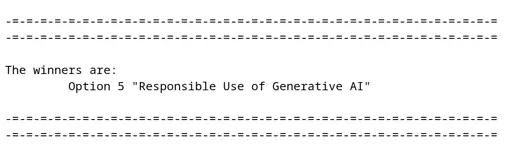
Contributors are expected to understand, review, test, and, where appropriate, modify AI-assisted output before incorporating it into Debian. Blindly accepting or uploading AI-generated material without appropriate human review is inconsistent with Debian’s established development practices. We [encourage] our contributors to disclose whether a contribution was made with AI [assistance], but do not require them to do so.
That last bit is a bad idea
I agree. Disclosure of A.I. use should be mandatory.
My main concern with A.I. use is its ability to hide incompetence. If a new agent introduces code that was entirely written by illegal-software that violates copyright law–A.I.–then that should be made clear, even if competent-programmers review the new inclusion and approve of it. Otherwise people are left with the impression that this new agent is a competent programmer. A.I. use–undisclosed–creates false reputations.
The disclosure being encouraged and not mandatory is purely to protect the egos of programmers currently utilizing A.I. products.
However I do respect their decision and I maintain projects should be self governing.
I disagree. For one, it’s unenforceable, just like outright banning it.
But AI assistance can also mean a lot of different things, from outright vibecoding through autocomplete up to only asking it to so review. It diminishes the human work in the eyes of other people, because a simple disclaimer doesn’t distinguish between the work done, and also encourages people to point out to AI as a scapegoat for their mistakes.
Good code always was and should always be one where a human is fully responsible for it; if you decide to vibecode and happens to end up with perfect code, good; if you write it fully yourself but it’s crap it doesn’t absolve you that you didn’t use AI…
It’s a tool, so use it responsibly like any other tool and stand behind your code no matter what tools you used.
I disagree. For one, it’s unenforceable, just like outright banning it.
If people thought “its impossible to catch everyone so why bother trying to catch anyone at all” when making laws, no laws would exist
But the issue is that in practise, there is no viable way to verify wether or not AI has been used at all. In other words, the disclosure of AI use entirely depends on the person providing the code, wether disclosure is mandated or not.
If there was enforcment to disclose AI use, it would create a false assumption that code which claims no AI use, is verified to contain mo AI use, which again, cannot be verified by anyone.
So it’s not that it’s hard to enforce, it’s not that it’s impossible to enforce 100%, it’s that there currently is no viable way to enforce it at all.
There’s a difference between “not being able to catch everyone” and having effectively no way to catch anyone.
And yes, unfortunately there are plenty of laws with the same issue (especially here and in the past decade or two) and it sucks - it only teaches people to ignore rules and a lot of them make you a criminal for no reason.
But there are ways to catch AI use
…elaborate? Anything that’s actually reliable?
THIS, THIS, THIS
Basically, a nirvana fallacy/perfect solution fallacy.
look at visual studio’s Intellisense and compare it to the last version that didn’t advertise Ai, there aren’t that many functional differences and if you don’t keep up with the marketing you could very easily miss that it is Ai powered.
I disagree. For one, it’s unenforceable, just like outright banning it.
Agreed. I an aware a lot of people contributed to the Linux kernel, without disclosing they used ai.
Good code always was and should always be one where a human is fully responsible for it; if you decide to vibecode and happens to end up with perfect code, good; if you write it fully yourself but it’s crap it doesn’t absolve you that you didn’t use AI…
Yeah. I do not blame the ai for writing the code, but rather the person to accept and push that code even if they know it is crap.
because a simple disclaimer doesn’t distinguish between the work done,
So just declare how you used the tool?
and also encourages people to point out to AI as a scapegoat for their mistakes.
Nonsense. Doing so is clearly abdicating the responsibility that you’re saying people need to have, and basically admitting you’re a bad developer.
So just declare how you used the tool?
That can quickly get complicated, and more importantly noone does that.
People who want to do it generally. Just call for a “metadata tag” in the commit.
The thing is, what are you actually trying to achieve with this disclosure? How does it help you?
If you’re going to treat AI assisted code the same way you treat human code (with a ton of scrutiny - which you absolutely should), then what is the point?
Do you also want to know what IDE was used, which autocomplete engine, or what OS?
GenAI replaces a lot of thinking. It is not on the same scale as those other tools. With an LLM, I can easily submit big chunk of code that does a thing, without understanding anything about how or why it does it. That’s not possible with just an IDE. Writing is a form of thinking that gives a much deeper unserstanding than reading and you dont get that with an LLM. That thought-bypass can rapidly become a maintainability issue, and increases the risk of major bugs going undetected.
I do respect their decision and I maintain projects should be self governing.
Me too, but I also think that governance isn’t as simple as “we get to decide what we do”, it also interacts with how well the decision-makers understand their domain and their broader it sits in, both of which are potentially reduced as a consequence of relying on AI.
Also there is the possibility of AI tools dominating workflows and then getting ripped away (either as the corporates raise costs, or the bubble bursts and they collapse), leaving a project overwhelmed with a unmanageably large array of weaknesses. In that scenario self-governance starts to become irrelevant.
My main concern with A.I. use is its ability to hide incompetence.
You mean like tab-completion in modern IDEs? Shouldn’t devs know all the function calls and methods of the standard libraries of the language they’re programming in?
Not at all, because it’s impossible to know for sure if committed code had some form of AI generated parts, AI assisted review, prototyping, etc.
By making it mandatory you can potentially alienate good developers who may feel their work ethics would be scrutinized negatively (like in these comments).
If you’re happy to use AI tools to develop, why would you not be happy to declare your use of those tools?
“Happy” is an odd choice of words here.
An LLM is just a tool. Some iterations have some value in some circumstances. In those cases it’s fine. But look around at the comments here and you’ll see many people basically accusing Debian of selling out. If a dev sees that reaction then they may not want to disclose their own use of LLMs.
Why would you not want to disclose though? Is it because of shame? Because you are unable to defend your choice? If it’s “just a tool”, is that not enough to defend your choice?
To be clear: the alternative policy we’re talking about isn’t “LLMs are bad, don’t use them”, it’s “Let us know when you are using LLMs”
Is it because of shame?
Yes, and because people might be afraid there going to be attacked for using it.
“Let us know when you are using LLMs”
But this is impossible to enforce.
this comment feels very reminiscent of the recent “if it was opt in nobody would opt in”
Sure. That’s what this is. Pointing out that a computer program can be used as a tool is definitely a parallel to privacy violations.
For example because you want to be judged for the actual code you submit and not the tools you use to create it by people biased against certain tools.
And how are they (Debian) going to to make sure this happens?
There’s no way to know for sure regardless. Having a policy allows them to take action when they do find it.
When people do code review off a pull request and sees it’s slop, it will go back to the developer to fix it. I guess if a person submit too much slop, they will get banned or something similar.
However, I don’t know the Debian process to have new code submitted, but would guess that it have to be more than one person to go from code to build a package.
Oh it definitely should be disclosed
This is disappointing… It would have been good to have at least one major distro that was AI free
This is a very hard decision to reverse out of if it turns out to be a problem in a few years
It would have been good to have at least one major distro that was AI free
Then you’d need to use one without the Linux kernel
Yes… That was also disappointing :(
The good news is that it could roll back to the current stable Trixie at any point
They’re gonna use AI for that too
It’s pretty much the same policy as the Linux kernel, but still disappointing.
I’ve been dumping things left and right as they decide Claude is their buddy, and that won’t stop because the same idiots who dropped decent init systems for that RedHat tech bro’s mess decided not to block it.
At least the kernel requires disclosure of AI use. The new Debian “policy” doesn’t even require that.
I am most concerned about that. If the legal position on copyright of AI code is decided in the future an audit or tracking of AI contributions in the codebase may be necessary to understand risk and exposure.
Granted you can’t make people disclose AI assistance with 100% accuracy but I would expect a majority to comply.
Yeah. I think we should seriously start organizing to create a Linux fork free of all that AI slop shit. It’s a huge task, but a really necessary one.
The Linux kernel project forces LLMs on all the devs.
The Linux Foundation, that has the Linux kernel project by the balls, forces LLMs on everyone involved.
That’s not at all true
There is no way to opt out of Sashiko.
That’s very Linus of them:
The mass-extinction causing orphan-crushing torment nexus is a tool, just like other tools we use. And it’s clearly a useful one.
There are other questions around it, like if we should be complicit in killing billions of people, and making more than 50% of genera go extinct, via its CO2e releases and water use, but “is it useful” is no longer one of those questions.
The Debian project has been and will continue to be about the technology.
Sure, the people who use it is important and often a very motivating part of the project, but in the end that’s a side benefit, not the point of the project.
In the Debian community we do open source because it results in better technology, not because of ethical reasons.
And so we make decisions primarily based on technical merit. Not fear of causing a mass extinction.
/s
The mass-extinction causing orphan-crushing torment nexus is a tool, just like other tools we use.
Well, obviously! Microsoft is using this tool too, and as we can all observe, that’s making their competing OS much better and much more desirable.
I trust their judgement here. I hope this is the right call.
Former Debian Project Leader Lucas Nussbaum expressed regret on the results of the vote, writing: “On a very personal note, I regret that the winning option does not acknowledge all the legitimate concerns around AI: environmental impact, copyright and licensing uncertainty, the health of Free Software communities, and the strain of aggressive scraping on the open web.”
char strawberry = “r”
Former Debian Project Leader Lucas Nussbaum expressed regret on the results of the vote, writing: “On a very personal note, I regret that the winning option does not acknowledge all the legitimate concerns around AI: environmental impact, copyright and licensing uncertainty, the health of Free Software communities, and the strain of aggressive scraping on the open web.”
It’s worth looking at the full results

IMHO: They talk about having it go through the exact same due diligence as normal contribs and a human has to be responsible. I think it’s an acceptable compromise.
A human cannot be responsible for AI written code.
Even if you personally vet every single line, you are still simply code reviewing an AI before you pass it to someone else.
A human did not write nor understand it, and thus cannot be responsible for it and thus should never submit it.
Not to mention the code review itself becomes a very tedious process: sifting through hundreds of lines of AI garbage and token expiry. It’s downright rude to expect a volunteer to check hundreds of lines of garbage you didnt even bother writing.
Signed, disgruntled software engineer who refuses to use my jobs “optional” ai feature
I don’t follow - if one does review and vet every line of code, how could one not understand it?
That’s the whole point of doing a code review.
Deeply disappointing. I was hoping it would be a refuge from AI infection.
At first I was afraid that they would allow for an irresponsible use. But no, they explicitly say “responsible”, so that danger is no more. I’m very much relieved.
Also they explicitly mention that humans will remain accountable. Not Nature, or Fate, or the gods; mark that. Good thinking there!
Problems solved.
humans will remain accountable
I see this a lot in clanker apologia, but it’s never clear what “accountable” actually entails. Unless it’s something of the order of a first-offense permanent ban from the project then it’s not going to dissuade anyone from being lazy meat proxies.
I’d expect this from Ubuntu but I was hoping for better from Debian… You know… Being as their whole shtick is stability.
Agreed, that was a large part of why I chose debian (and never considered ubuntu) as my ‘back up’ distro, just in case my distro of choice (or arch above it) decided to do something daft.
Debian seemed like the logical choice
Alright, what are the alternatives folks?
Gentoo? Gentoo!
(But I’ll keep watch to see of they don’t revert course because “the models are now too powerful”, since it is a policy from 2024)
The policy
Gentoo Council has voted on 2024-04-14 on the following policy:
It is expressly forbidden to contribute to Gentoo any content that has been created with the assistance of Natural Language Processing artificial intelligence tools. This motion can be revisited, should a case be made for such a tool that does not pose copyright, ethical and quality concerns.
This policy affects Gentoo contributions and the official Gentoo projects. It does not prohibit adding packages for AI-related software or software that is being developed with the help of such tools upstream.
I genuinely wonder how they’re going to square this policy with LLM code in the kernel.
Personally, I’m guessing that all distros will eventually bend and allow LLM code.
I think this bit makes it clear that shipping LLM code from the kernel that wasn’t contributed by Gentoo is fine:
This policy affects Gentoo contributions and the official Gentoo projects. It does not prohibit adding packages for AI-related software or software that is being developed with the help of such tools upstream.
When an LLM agent reports a huge security bug and provides the solution and the only solution is explicitly exactly what it wrote.
Checkmate!
chimera-linux https://chimera-linux.org/community/#project-ai-policy
Chimera has a strong no-AI policy for contributions in all of its repositories. Contributors found using LLMs will be barred from further contributing to the project.
We take objection against the use of LLMs primarily on ethical grounds. This is based on many factors, including societal impact of LLM use, ecological impact, and others. We reject arguments about “useful tools” and similar, because technical aspects can never be considered in isolation.
LLM-using contributions additionally have a disproportionate burden on reviewers, their mental health, as well as project resources, which we have limited amounts of.
Chimera is a small project and has limited control over what upstreams do, particularly due to dependencies and widespread use of LLM usage in projects nowadays. We try to do the right thing when possible, preferring appropriate alternatives and so on.
disclose whether a contribution was made with AI but do not require them to do so
How is that good? “You should, but if you don’t … nothing happens”
responsible use
Completely subjective and therefore absolutely meaningless when setting up rules/guidelines
“Responsible use of AI”? Is that a joke? There is no such a thing as responsible use of AI. Responsible people would refuse to use AI.
But anyway, Linux is already AI. Sticking to any one of those BSDs is the only way out.
NetBSD explicitly don’t allow AI code
You CAN use AI responsibly, it’s just not worth doing, most of the time. It would cost more than just not using it in the first place.
Get ready for the ISO to double in size