

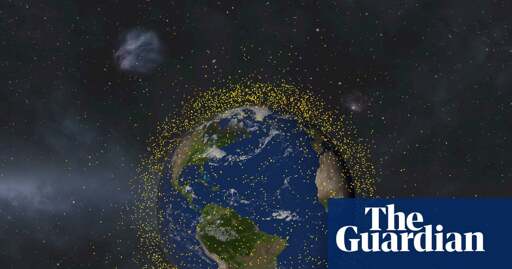
In the 21st century, private companies began to launch satellites at unprecedented rates. Today, Earth’s orbit is packed with thousands of satellites and fragments – around 32,000 in total – all circling the planet at immense speed. This is even after accounting for the fact that a lot of satellites have fallen out of orbit and been destroyed.
Some reports suggest that by the end of this decade there could more than 60,000 active satellites in space. Launch by launch, what began with a handful of scientific and military spacecraft has accelerated into a constant flow of objects, publicly and privately owned, placed into different orbital lanes, each serving a variety of purposes.
There is now a diverse collection of satellites spinning around the globe, including communication and weather satellites, navigation satellites and Earth observation technology that takes images of the surface.
The surge in orbital activity has created a significant collision risk. There have already been crashes, including a 2009 event where a US satellite hit a defunct Russia military satellite. Tens of thousands of tiny fragments of metal are now spinning at high velocities.
The big fear is that future collisions will cause a domino effect where Earth’s orbit becomes cluttered with tiny, high-speed bits of metal. That could create a near-impenetrable layer of debris that would make space launches so dangerous it would essentially trap humans on Earth.
On the one hand, Kessler syndrome is scary. On the other hand, space is bigger than you think it is. Imagine the same article, but it’s about 32,000 cars, boats, and airplanes spread around the land, seas, and sky. Reports say there could be as many as 60,000 such vehicles within the next decade. Collisions between such small entities across such a large area are unlikely, especially when they’re at wildly different altitudes.
But on the other other hand, Kessler syndrome is the basis of one of my favorite animes so I still like when it comes up
It’s not like when two satellites collide they just fall to earth and stop causing problems.
If cars and boats created vast clouds of shrapnel that kept moving around when they collided, hitting other cars and boats and creating more shrapnel, the roads and seas would be impassable.
Untrackable shrapnel moving at up to 18,000 miles per hour…
18,000 miles per hour orbital velocity, but it’s maybe a couple hundred miles per hour relative to any satellite it could realistically hit
That entirely depends on their inclination and where in their respective orbits they collide. Orbits can intersect at right angles even with relatively low inclination, meaning they’re colliding at those orbital speeds.
I mean, in LEO they kinda do. The majority of our satellites are in low orbit, and require regular boosts to stay in orbit. Atmospheric drag is still a problem out to thousands of miles. Also, I can’t stress this enough, space is bigger than you think, and satellites are tiny. There is only a risk of collision at the point where two orbits intersect, if both satellites are at that point at the same time. Maybe if you have 12,000 satellites all orbiting at the exact same altitude with different inclinations, it could be an issue for those satellites. I’m not convinced that it’s ever going to be a barrier to space travel.
The key is the number of course corrections that are done currently to avoid collisions, there are multiple a week atm (it’s up to half a dozen per week). Increase the density of satellites and the number of corrections increaes at a function greater linear. Stands to reason that with multiple companies and governments all doing course corrections then someone will zig when they should have zagged.
I’ve played enough KSP ‘stranded astronaut’ missions to know how difficult it is to get orbits to match up like that. And KSP’s physics is less complicated than real life.
It’s not hard once you “figured it out”, same as a lot of other things. KSP is just people figuring it out for the first time, and yes, that is hard and what you experienced. But when you do it 500 times, the 500th time is super easy.
And also, I have a mod in KSP where I just click one button and it gives me an orbital maneuver to rendezvous different vessels. If you use the right tools, it gets even easier.
Yes, space is big, but those objects are moving fast on intersecting paths. I’d recommend checking this out and also following @[email protected]
Yeah. What people don’t seem to realize is that even though space is big, it’s still really crowded in near earth orbits.
The crash clock answers the question:
Say there were some dumb thing like an expired SSL certificate that prevented earth to ground communication. Just 6 years ago, you’d have half a year to resolve the issue before you’d expect there to be a collision. As of March 2026 it’s down to just 3 days.
All these megaconstellation plans have big plans of scaling up exponentially, and that means the clock is constantly creepinc closer. At some point a strong enough solar flare could cause a long enough comms blackout.
But the main thing with the clock is that it also displays how often corrective maneuvers are needed. The more maneuvers are being made, the higher the chance of errors. I think that’s the real danger here. Starlink is scaling up massively and they have numerous competitors, including China. All it takes is a miscommunication and the snowball of kessler syndrome might start rolling.
Yeah, and that’s the core of the Kessler Syndrome issue. Right now, if everything goes well you still have 3 days to get the maneuvers in before stuff starts crashing. But, screw up once and now there’s even more space debris and the window to make those maneuvers gets even smaller. Eventually even if you have full control of the remaining satellites, there are so many collisions happening that you can’t get maneuvers to them fast enough before there are more cascading collisions.
And, recent events showed that you don’t even need a collision. A Starlink satellite just blew up this week on its own. Who knows what happened, but where there used to be 1 satellite they’re now tracking one object surrounded by a bunch of debris.
Okay, I’m willing to grant it. If all maneuvers were to stop, there’s a roughly 50% chance that one satellite would impact another satellite in about three days. I’m still not convinced it’s an issue. What is the risk to something like the ISS or Hubble or anything in a geosynchronous orbit, versus the risk to starlink-31,299?
When an impact happens, the next one becomes much more likely with all that shrapnel flying around. If the biggest starlink layer becomes a minefield of shrapnel, passing it to reach the ISS becomes much more angerous. Same goes for any other launch, including GEO.