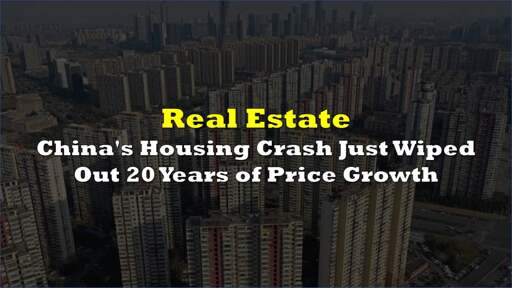
Inflation-adjusted home prices in China have fallen below where they started two decades ago, and the fiscal fallout is hitting local governments even harder than developers.
It fits somewhat with American sunbelt cities where there is significant growth and large developers building new houses. One issue which is common across borders is that real estate was a common way for people to invest their retirement savings; wiping out a lot of the savings of people near or at retirement isn’t healthy. One issue that is more local to China is that Chinese provinces and municipalities have little ability to raise taxes, so they’ve been using development as a way to raise money; a lot of these governments have a lot of debt and few good ways to pay it back.
It’s great for people who want to buy a house, great for ultra rich that want to buy out more property, but absolutely fucking people who just bought a house not too long ago.
If you just bought (assuming standard 30 yr mortgage), all you have to do is hold through it. Refinance if that becomes favorable.
The only losers are those who are free and clear or toward the end of their mortgage AND looking to utilize the equity they built up, OR anyone looking to sell. The solution is time, which can kinda suck, but it’s vastly preferable to not having a place to live.
The solution is only time if market starts bubbling again, like it did after the last crash. Its also possible for asset prices to stagnate for decades, and its happened before.
why? yiu bought a home to live in right ? you can still live in it. thet they’re now cheaper for other folks who couldn’t afford a home before, is a good thing.
I feel like people forget that a significant portion of America lives in a place where the cost-of-living isn’t ridiculously high. A housing crash might make houses slightly more affordable in San Francisco, but it would be economically devastating to the interior of the country.
Honestly it probably wouldn’t even be that great for people who wanted to buy a house. Banks aren’t likely to start handing out mortgages to people who couldn’t afford the house a couple weeks ago in what is now a volatile market, and you would still be competing with companies who could pay cash.
That is how supply and demand works, though. If the prices drop, and suddenly cash buyers start pouring out of the woodwork, that will drive prices back up.
When you see prices fall, it necessarily means the cash buyers are not just swooping in and grabbing everything.
I promise I understand what you’re saying. I’m saying the fault in your logic is misunderstanding the upward pressure of cash buyers.
When prices fall, it isn’t chum in the water for corporate cash buyers. What it means is that those same buyers were ALWAYS there, and are now leaving. The absence of thier buy pressure is the cause of the prices falling.
I didn’t realize San Francisco is the only city in the US. Rent in every single urban area is out of control. A two bedroom apartment that I rented in Lexington, KY from 1996-2011 for $500 a month is now $1,800.
A studio apartment that I rented in Altoona, PA from 2011- 2013 for $700 a month is now $1200.
I could keep looking, as I have rented places in 38 states.
No where that isn’t rural is cheap in the US anymore. Even the most “affordable” cities are boasting about 1 br apartments that are $1,000+ a month.
Yeah, I moved out of my parents’ place in the early 2010’s. My rent was $1000. It was a shithole, but I could at least afford it. I just checked that area, and found that my old unit is up for rent. They’re demanding $2100 for it now.
It’s not just going up due to inflation adjustments. Adjusting for inflation from 2010 to now would have it closer to $1500. And that’s being generous (I added a few years to the inflation calculation) because I moved out in the early 2010’s, not exactly in 2010.
And looking at the photos they have posted for the unit, it’s still a shithole. I’m pretty sure the awful stove/oven in the kitchen photos is the exact same one I used back in the early 2010’s. The stove even has the scuffed dent in the corner from when a dumbbell weight rolled off the top of the fridge and landed on it. So it’s not like they’re actively reinvesting that money back into the units to increase value to the tenants.
So somehow the slumlords have managed to tack on an extra ~$7200 in annual profit per tenant. that’s a significant amount of cash, especially when you consider how long the prices have been inflated.
I hate to break it to you but those prices are barely more than inflation. $700 in 2011 is $1065 today. And I didn’t say anything about San Francisco being the only city in the US now you’re just reaching.
A few years ago in China a guy went viral on billibilli (their version of YouTube) for covering how hard it was to be retired in China. The CCP took his Channel away and censored him. Funnily enough in the years since the CCP has made strides in increasing the payout of their social security system.
So they censored him and then responded to the criticism anyway.
Honestly --minus the censorship-- I wish the US would handle it this way. Stop relying on 401ks and housing value to backstop peoples retirement and increase social security payouts. The elderly have earned their right to take a break from the grind of capitalism. They should be relaxing and passing on what they’ve learned from their time on earth to the next generation.
My relaxation plan is suicide. Just like other millineals. Even though I’ve done way above average, there is no way I’ll ever retire. It’s literally illigical for me to not commit suicide. Who wants to be exhausted with nothing to look forward to?
That would make the wealthy very happy if you did that. They wouldn’t have to pay taxes for your retirement.
My advice – if you can’t overcome your cynicism, go on to spite those fuckers who refuse to pay you enough for a comfortable retirement. To spite those who have denied you hope for the future, who want to work you to the bone and throw you in the trash.
Fuck those people, every breath you take is one less breath for Elon.
Having said that, we can organize and fight for a kinder world, that includes better social security that can pay for a comfortable retirement with people you care about. Don’t let your cynicism devour you.
A better world is possible, take action. Join DSA or start a union or join another org. Mamdani has proven the system is not invincible.
I have tried and tried. Got three STEM degrees and 20 years experience, and still never known job security. Now I’m about to be laid off again. I’m tired boss. My family can survive if I check out, but might not if I don’t. It’s a bit of a situation.
It’s not spite to continue being exhausted so a few assholes can be rich. I feel like it’s more harmful to live. I’m also coming to terms that I’m a miserable person, so maybe I was never meant to be here in the first place.
It sounds like you have people around you who care about you. I don’t know how much I, a random stranger on the internet can help. But know you’re not alone in your feelings. Consider seeking out professional help if you’re able to.
It may very well be irrational to keep on going. The universe doesn’t guarantee us a happy existence. But understand it’s irrational from a place of ego. Other people need you for their emotional well being if nothing else.
Hope is a thing with feathers, it may return someday. We must embrace hope long past time when it is rational, so that someday it may pirch again. Even if not for us.
This video has helped me work through these feelings some.
Friend, there are millions of us millennials out here who are in the same boat. You are not alone. I am confident we will, as a generation, improve living conditions for all of us in this lifetime. Capitalism is in its death throes and it sucks that we have to deal with all of the side effects of that, but we have the power to forge new ways of living, and will likely have no choice but to do just that in the near future.
When you topple the existing power structure, it doesn’t guarantee that the next one is whichever you try ushering in. As propaganda-riddled as these points remain, the USSR a China are good examples. They went for communism but got something else in return.
Second point is that you will have to deal with propaganda. People will point to the dynamics of a power vacuum and blame the failures of handling that directly onto communism itself. So you’ll hear that communism leads to dictatorship. The truth is, change is dangerous. Communism alone doesn’t deserve the blame.
Third point is that you won’t be able to trust many people. If you have a good idea, some adversaries will try to convince you that it’s a bad one. If you have a bad idea, some adversaries will make you out to be the devil so that you loose support. Other adversaries might try to convince you that your bad idea is a good one. Either way, the goal is the same—your failure. These adversaries want their preferred way of life, not yours, and so you’re now competing.
Handling all of this is tough. If you die, who knows what person with what narrative takes your place? Assuming you dismantled the power structures that preserved the prior status quo, there’s now nothing left to steer the ship toward the good.
All of these points are making the assumption that the system we currently have is just hunky dorey. Millions die of poverty and treatable illnesses in the US every year. Isn’t that dangerous? We are all subject to the whims of a tiny minority of sadistic billionaire warmongers and business owners who have captured our news and social media and all of the branches of government. Isn’t that dangerous? You’re just going to accept that we live in a country in which there is ever growing homelessness and preventable death because you’re afraid that a people’s revolution might not turn out as expected?
That’s not at all what I said. I’m not scared. In fact, I wish I could be the one to lead it. Because I know that I would respect the risks. I can’t say that I fully understand them, but I have something more than many people from the past… I have knowledge of their results. I know that I could be careful, that I could pour my life blood into such a project and ensure its successful completion at the expense of every fiber in my body. I’d educate myself, I’d hire experts, I’d build telemetry and run tests… I’d have a damn good plan, because it would take me years in the making. I have confidence there.
My concern is that I’m actually just a nobody. So, however such a revolution should take place, I point back to what I actually said…
That’s cool but you’re coming from a very individualistic perspective. Any kind of revolution would be futile without the support of a mass labor movement that encourages workers to stand up for themselves and organize, something which needs to be the left’s main objective before we can even think of revolution. A future disciplined vanguard party will serve the role you are talking about. But without a mass movement, any revolution would be crushed by the overwhelming power of the capitalist police state.
So they censored him and then responded to the criticism anyway.
Being criticized meant they were losing face. Saving face is very important in many Asian cultures.
Stop relying on 401ks and housing value to backstop peoples retirement and increase social security payouts
Not gonna work in an aging society unfortunately. Social security payouts come from current taxes. If you don’t have enough young people, you can’t really fund social security. If you have a national pension fund that collects money for your retirement as YOU work, it’s not too different from a 401k, the only difference is who has control over it. Most countries don’t do that though.
Fun story: My country has a system similar to 401k (it has deferred taxation, reduced taxation and government matching, so basically free money), but you couldn’t take money out of it until retirement… Until a few years ago when conservatives changed it, so now you can take money out, but if you do, you pay full taxes and you can’t resume payments for 10 years. At least a third of the country took that opportunity. Our equivalent of social security hasn’t been significantly increased and in fact retirement age is being raised by roughly a month a year currently because otherwise the system would become unaffordable. At this point I’m considering cashing mine in in a few years only because I’m afraid that if the conservatives get enough power they’ll manage to pass some stupid ass law taking away everyone’s funds and using it to fund increased social security for their current old voters, at which point I’ll just lose all of it unlike the people who have taken theirs out.
All forms of retirement are funded by current workers. Social security is just more honest about it. A retired person is still consuming goods and services produced by the working without producing anything themselves.
You’re presenting your argument as if it were fact. Which is how conservatives always try to frame their arguments around social security.
Basic question, if its so impossible for it to work why is China able to do it?
Basic answer, it’s not impossible – it just requires a progressive taxation for social security where the rich pay into it more. Which is why conservatives are so against it.
Look man, money is fake the only question that ultimately matters is ‘can we produce enough stuff?’. Which in the context of modern industrial production the answer is ‘in most cases, yes’.
Certainly in terms of producing enough housing and food for the elderly the answer is yes. The only place where there might be a limitation for the elderly is healthcare. If you gotta problem with that maybe we should adopt Cuba’s healthcare system. They have more doctors per capita than any other nation on earth in spite of decades of crippling sanctions. Before Trump reintroduced the blockade they also had higher life expectancy than the US.
Maybe a pension system should be managed that way for inflationary reasons. But money does not exist until the state spends it into the economy. Dollars do not exist in nature.
Building and renting out should be profitable. Else nothing is built for renters. Problem is companies buying homes (not building) and try to bribe local politics to upgrade zoning laws for more profitable housing (more flats per m2 land, less living quality). There are cases where lots should be merged for upgrading zonings but this should come from the communities needs not companies’ greeds.
Building and renting out should be non-profit based. It should cover it’s cost, but not be attractive to investors - that keeps the prices from rising. Doesn’t mean that the people doing this work shouldn’t be able to live a decent life, but non-profits can pay normal salaries too.
The result is property developers buying up swathes of land and leaving it vacant until the market reaches a frenzy and they can charge an unholy price for their crappy tract homes built by subcontractors under extreme cost reduction pressures. It doesn’t meet market demand, not remotely.
Zoning and local councils are certainly complicit.


Good. The way it should be. Housing is not wealth storage, it’s a place to live.
Let’s hop this fall spreads out of China.
The kiwis in New Zealand have seen the prices fall by a third iirc
15% lower than it’s all time 2022 peak right now
Because everyone is fucking off to Australia.
That does assume the Chinese housing market is the same as in many western countries though. But if so, bring it on.
It fits somewhat with American sunbelt cities where there is significant growth and large developers building new houses. One issue which is common across borders is that real estate was a common way for people to invest their retirement savings; wiping out a lot of the savings of people near or at retirement isn’t healthy. One issue that is more local to China is that Chinese provinces and municipalities have little ability to raise taxes, so they’ve been using development as a way to raise money; a lot of these governments have a lot of debt and few good ways to pay it back.
It’s great for people who want to buy a house, great for ultra rich that want to buy out more property, but absolutely fucking people who just bought a house not too long ago.
If you just bought (assuming standard 30 yr mortgage), all you have to do is hold through it. Refinance if that becomes favorable.
The only losers are those who are free and clear or toward the end of their mortgage AND looking to utilize the equity they built up, OR anyone looking to sell. The solution is time, which can kinda suck, but it’s vastly preferable to not having a place to live.
The solution is only time if market starts bubbling again, like it did after the last crash. Its also possible for asset prices to stagnate for decades, and its happened before.
why? yiu bought a home to live in right ? you can still live in it. thet they’re now cheaper for other folks who couldn’t afford a home before, is a good thing.
These are Mom and pop speculators. There are entire cities in China with empty housing bought on speculation. The appeal of free money was too great.
I feel like people forget that a significant portion of America lives in a place where the cost-of-living isn’t ridiculously high. A housing crash might make houses slightly more affordable in San Francisco, but it would be economically devastating to the interior of the country.
Honestly it probably wouldn’t even be that great for people who wanted to buy a house. Banks aren’t likely to start handing out mortgages to people who couldn’t afford the house a couple weeks ago in what is now a volatile market, and you would still be competing with companies who could pay cash.
Actually when things are less expensive they are easier to buy.
For everyone… not just poor people who need a loan, but people who can pay cash too… which is what I said.
That is how supply and demand works, though. If the prices drop, and suddenly cash buyers start pouring out of the woodwork, that will drive prices back up.
When you see prices fall, it necessarily means the cash buyers are not just swooping in and grabbing everything.
Yes which would mean that the cash buyers would have all the houses and the people who needed loans wouldn’t. Which was my point.
That is not what that means.
I promise I understand what you’re saying. I’m saying the fault in your logic is misunderstanding the upward pressure of cash buyers.
When prices fall, it isn’t chum in the water for corporate cash buyers. What it means is that those same buyers were ALWAYS there, and are now leaving. The absence of thier buy pressure is the cause of the prices falling.
The fault in your logic is thinking there won’t be more cash buyers if prices dropped.
Less than 20% is significant?
https://www.census.gov/newsroom/press-releases/2022/urban-rural-populations.html
I didn’t realize only rural areas had a lower cost of living than San Francisco…
I didn’t realize San Francisco is the only city in the US. Rent in every single urban area is out of control. A two bedroom apartment that I rented in Lexington, KY from 1996-2011 for $500 a month is now $1,800.
A studio apartment that I rented in Altoona, PA from 2011- 2013 for $700 a month is now $1200.
I could keep looking, as I have rented places in 38 states.
No where that isn’t rural is cheap in the US anymore. Even the most “affordable” cities are boasting about 1 br apartments that are $1,000+ a month.
Yeah, I moved out of my parents’ place in the early 2010’s. My rent was $1000. It was a shithole, but I could at least afford it. I just checked that area, and found that my old unit is up for rent. They’re demanding $2100 for it now.
It’s not just going up due to inflation adjustments. Adjusting for inflation from 2010 to now would have it closer to $1500. And that’s being generous (I added a few years to the inflation calculation) because I moved out in the early 2010’s, not exactly in 2010.
And looking at the photos they have posted for the unit, it’s still a shithole. I’m pretty sure the awful stove/oven in the kitchen photos is the exact same one I used back in the early 2010’s. The stove even has the scuffed dent in the corner from when a dumbbell weight rolled off the top of the fridge and landed on it. So it’s not like they’re actively reinvesting that money back into the units to increase value to the tenants.
So somehow the slumlords have managed to tack on an extra ~$7200 in annual profit per tenant. that’s a significant amount of cash, especially when you consider how long the prices have been inflated.
I hate to break it to you but those prices are barely more than inflation. $700 in 2011 is $1065 today. And I didn’t say anything about San Francisco being the only city in the US now you’re just reaching.
Not reaching, just using your own hyperbole in reverse.
I hate to break it to you, but inflation hasn’t done a thing to minimum wage, or wages in general.
In what way was pointing out that there are places in America with a lower cost of living than San Francisco that aren’t rural hyperbole?
I never said it did, in fact that has absolutely nothing to do with what I’m talking about.
The problem is that a lot of Chinese elderly used housing as a storage of wealth.
A few years ago in China a guy went viral on billibilli (their version of YouTube) for covering how hard it was to be retired in China. The CCP took his Channel away and censored him. Funnily enough in the years since the CCP has made strides in increasing the payout of their social security system.
So they censored him and then responded to the criticism anyway.
Honestly --minus the censorship-- I wish the US would handle it this way. Stop relying on 401ks and housing value to backstop peoples retirement and increase social security payouts. The elderly have earned their right to take a break from the grind of capitalism. They should be relaxing and passing on what they’ve learned from their time on earth to the next generation.
My relaxation plan is suicide. Just like other millineals. Even though I’ve done way above average, there is no way I’ll ever retire. It’s literally illigical for me to not commit suicide. Who wants to be exhausted with nothing to look forward to?
That would make the wealthy very happy if you did that. They wouldn’t have to pay taxes for your retirement.
My advice – if you can’t overcome your cynicism, go on to spite those fuckers who refuse to pay you enough for a comfortable retirement. To spite those who have denied you hope for the future, who want to work you to the bone and throw you in the trash.
Fuck those people, every breath you take is one less breath for Elon.
Having said that, we can organize and fight for a kinder world, that includes better social security that can pay for a comfortable retirement with people you care about. Don’t let your cynicism devour you.
A better world is possible, take action. Join DSA or start a union or join another org. Mamdani has proven the system is not invincible.
I have tried and tried. Got three STEM degrees and 20 years experience, and still never known job security. Now I’m about to be laid off again. I’m tired boss. My family can survive if I check out, but might not if I don’t. It’s a bit of a situation.
It’s not spite to continue being exhausted so a few assholes can be rich. I feel like it’s more harmful to live. I’m also coming to terms that I’m a miserable person, so maybe I was never meant to be here in the first place.
It sounds like you have people around you who care about you. I don’t know how much I, a random stranger on the internet can help. But know you’re not alone in your feelings. Consider seeking out professional help if you’re able to.
It may very well be irrational to keep on going. The universe doesn’t guarantee us a happy existence. But understand it’s irrational from a place of ego. Other people need you for their emotional well being if nothing else.
Hope is a thing with feathers, it may return someday. We must embrace hope long past time when it is rational, so that someday it may pirch again. Even if not for us.
This video has helped me work through these feelings some.
Friend, there are millions of us millennials out here who are in the same boat. You are not alone. I am confident we will, as a generation, improve living conditions for all of us in this lifetime. Capitalism is in its death throes and it sucks that we have to deal with all of the side effects of that, but we have the power to forge new ways of living, and will likely have no choice but to do just that in the near future.
Just need to be extremely careful.
When you topple the existing power structure, it doesn’t guarantee that the next one is whichever you try ushering in. As propaganda-riddled as these points remain, the USSR a China are good examples. They went for communism but got something else in return.
Second point is that you will have to deal with propaganda. People will point to the dynamics of a power vacuum and blame the failures of handling that directly onto communism itself. So you’ll hear that communism leads to dictatorship. The truth is, change is dangerous. Communism alone doesn’t deserve the blame.
Third point is that you won’t be able to trust many people. If you have a good idea, some adversaries will try to convince you that it’s a bad one. If you have a bad idea, some adversaries will make you out to be the devil so that you loose support. Other adversaries might try to convince you that your bad idea is a good one. Either way, the goal is the same—your failure. These adversaries want their preferred way of life, not yours, and so you’re now competing.
Handling all of this is tough. If you die, who knows what person with what narrative takes your place? Assuming you dismantled the power structures that preserved the prior status quo, there’s now nothing left to steer the ship toward the good.
All of these points are making the assumption that the system we currently have is just hunky dorey. Millions die of poverty and treatable illnesses in the US every year. Isn’t that dangerous? We are all subject to the whims of a tiny minority of sadistic billionaire warmongers and business owners who have captured our news and social media and all of the branches of government. Isn’t that dangerous? You’re just going to accept that we live in a country in which there is ever growing homelessness and preventable death because you’re afraid that a people’s revolution might not turn out as expected?
That’s not at all what I said. I’m not scared. In fact, I wish I could be the one to lead it. Because I know that I would respect the risks. I can’t say that I fully understand them, but I have something more than many people from the past… I have knowledge of their results. I know that I could be careful, that I could pour my life blood into such a project and ensure its successful completion at the expense of every fiber in my body. I’d educate myself, I’d hire experts, I’d build telemetry and run tests… I’d have a damn good plan, because it would take me years in the making. I have confidence there.
My concern is that I’m actually just a nobody. So, however such a revolution should take place, I point back to what I actually said…
That’s cool but you’re coming from a very individualistic perspective. Any kind of revolution would be futile without the support of a mass labor movement that encourages workers to stand up for themselves and organize, something which needs to be the left’s main objective before we can even think of revolution. A future disciplined vanguard party will serve the role you are talking about. But without a mass movement, any revolution would be crushed by the overwhelming power of the capitalist police state.
Being criticized meant they were losing face. Saving face is very important in many Asian cultures.
Not gonna work in an aging society unfortunately. Social security payouts come from current taxes. If you don’t have enough young people, you can’t really fund social security. If you have a national pension fund that collects money for your retirement as YOU work, it’s not too different from a 401k, the only difference is who has control over it. Most countries don’t do that though.
Fun story: My country has a system similar to 401k (it has deferred taxation, reduced taxation and government matching, so basically free money), but you couldn’t take money out of it until retirement… Until a few years ago when conservatives changed it, so now you can take money out, but if you do, you pay full taxes and you can’t resume payments for 10 years. At least a third of the country took that opportunity. Our equivalent of social security hasn’t been significantly increased and in fact retirement age is being raised by roughly a month a year currently because otherwise the system would become unaffordable. At this point I’m considering cashing mine in in a few years only because I’m afraid that if the conservatives get enough power they’ll manage to pass some stupid ass law taking away everyone’s funds and using it to fund increased social security for their current old voters, at which point I’ll just lose all of it unlike the people who have taken theirs out.
All forms of retirement are funded by current workers. Social security is just more honest about it. A retired person is still consuming goods and services produced by the working without producing anything themselves.
You’re presenting your argument as if it were fact. Which is how conservatives always try to frame their arguments around social security.
Basic question, if its so impossible for it to work why is China able to do it?
Basic answer, it’s not impossible – it just requires a progressive taxation for social security where the rich pay into it more. Which is why conservatives are so against it.
Look man, money is fake the only question that ultimately matters is ‘can we produce enough stuff?’. Which in the context of modern industrial production the answer is ‘in most cases, yes’.
Certainly in terms of producing enough housing and food for the elderly the answer is yes. The only place where there might be a limitation for the elderly is healthcare. If you gotta problem with that maybe we should adopt Cuba’s healthcare system. They have more doctors per capita than any other nation on earth in spite of decades of crippling sanctions. Before Trump reintroduced the blockade they also had higher life expectancy than the US.
Increase social security payouts with what?
Yes, everyone should have a pension plan, but you have to pay into that.
No you don’t, money is fake, we made it up.
Maybe a pension system should be managed that way for inflationary reasons. But money does not exist until the state spends it into the economy. Dollars do not exist in nature.
Building and renting out should be profitable. Else nothing is built for renters. Problem is companies buying homes (not building) and try to bribe local politics to upgrade zoning laws for more profitable housing (more flats per m2 land, less living quality). There are cases where lots should be merged for upgrading zonings but this should come from the communities needs not companies’ greeds.
Building and renting out should be non-profit based. It should cover it’s cost, but not be attractive to investors - that keeps the prices from rising. Doesn’t mean that the people doing this work shouldn’t be able to live a decent life, but non-profits can pay normal salaries too.
The result is property developers buying up swathes of land and leaving it vacant until the market reaches a frenzy and they can charge an unholy price for their crappy tract homes built by subcontractors under extreme cost reduction pressures. It doesn’t meet market demand, not remotely.
Zoning and local councils are certainly complicit.
Nothing should be profitable outside helping your fellow men. Fuck Capitalism. Scientific Socialism is the only sustainable way forward.