I confess, I’m guilty. I’ve used AI to diagnose random issues with my little personal blog (please don’t hate me, I’m just a man without a degree). That said, I understood the simple code well enough to see what I was getting wrong and comprehend the AI generated suggestion, so it wasn’t all that different than looking things up on a wiki and implementing it. The primary difference, for me, was that I had already spent two weeks digging deeper and deeper for my answers, only finding outdated or incorrect information, and Claude delivered the correct answer in about 10 seconds.
In my opinion, the reason it was a good idea to implement the AI generated code was that I understood it. There was a human brain looking at that result and going “aha! I see what I was missing!” If I hadn’t understood what I was looking at, it could have been doing anything, and I wouldn’t have felt comfortable implementing it. If I hadn’t at least tried to the old fashioned way first, I wouldn’t have used it. But after weeks of hitting dead ends and with the knowledge that there was an extremely powerful tool that could give me my answer in seconds, it began to feel foolish to continue punishing myself with wasted time.
In Linus’ case, I think it is safe to say he understands enough about Linux to interpret the AI suggestions and be a safeguard against slop. I’m not too concerned about his contributions to the kernel if he’s using AI to think outside the box or diagnose a complicated problem.
But! There is a major risk factor when people start implementing code that they don’t understand, or when it is a crutch for their total lack of comprehension. Vibe coding and using a diagnostic tool are different things. I hope Linus gives some real thought to the realistic limits that need to be in place for people who aren’t knowledgeable enough to filter AI suggested code through their own brains, because it wouldn’t take long to destroy a reliable system like Linux if they incorporate AI generated code with no experienced human in the drivers seat.
Apologies to those who just fundamentally hate AI and think I’m a fool for using it, I just wanted to share my experience as an unschooled computer nerd who finally gave in and tried it out a couple of times.
Educated computer nerd here. AI has fundamentally changed how you do CS in industry, it’s completely unavoidable at this point and not using it in some capacity is doing yourself a massive disservice. It’s able to catch edge cases we’d never have caught otherwise. The important part is indeed understanding what it’s doing and keeping contributions organized/concise.
That doesn’t make it any less scary from an ethics and model oversight perspective, but from the perspective of the project it is fundamentally just another tool. Linus appears to feel this way too. Frankly I’d be more concerned if there weren’t people using AI on Linux, especially to validate kernel level security.


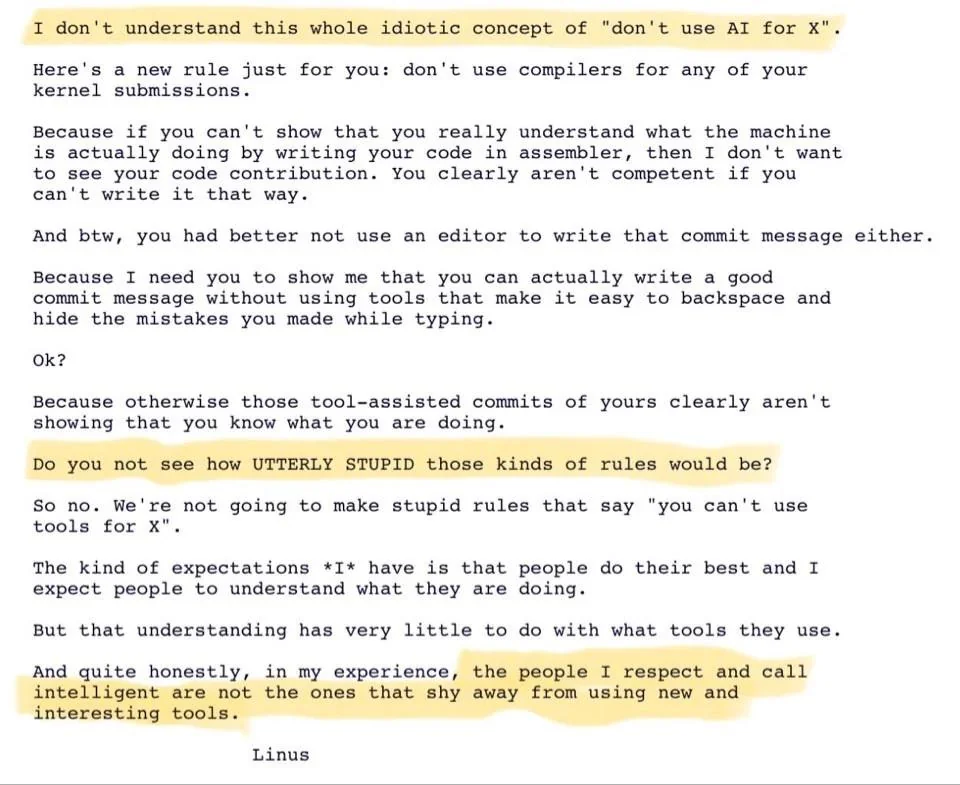
I have mixed opinions on his stance towards AI.
I confess, I’m guilty. I’ve used AI to diagnose random issues with my little personal blog (please don’t hate me, I’m just a man without a degree). That said, I understood the simple code well enough to see what I was getting wrong and comprehend the AI generated suggestion, so it wasn’t all that different than looking things up on a wiki and implementing it. The primary difference, for me, was that I had already spent two weeks digging deeper and deeper for my answers, only finding outdated or incorrect information, and Claude delivered the correct answer in about 10 seconds.
In my opinion, the reason it was a good idea to implement the AI generated code was that I understood it. There was a human brain looking at that result and going “aha! I see what I was missing!” If I hadn’t understood what I was looking at, it could have been doing anything, and I wouldn’t have felt comfortable implementing it. If I hadn’t at least tried to the old fashioned way first, I wouldn’t have used it. But after weeks of hitting dead ends and with the knowledge that there was an extremely powerful tool that could give me my answer in seconds, it began to feel foolish to continue punishing myself with wasted time.
In Linus’ case, I think it is safe to say he understands enough about Linux to interpret the AI suggestions and be a safeguard against slop. I’m not too concerned about his contributions to the kernel if he’s using AI to think outside the box or diagnose a complicated problem.
But! There is a major risk factor when people start implementing code that they don’t understand, or when it is a crutch for their total lack of comprehension. Vibe coding and using a diagnostic tool are different things. I hope Linus gives some real thought to the realistic limits that need to be in place for people who aren’t knowledgeable enough to filter AI suggested code through their own brains, because it wouldn’t take long to destroy a reliable system like Linux if they incorporate AI generated code with no experienced human in the drivers seat.
Apologies to those who just fundamentally hate AI and think I’m a fool for using it, I just wanted to share my experience as an unschooled computer nerd who finally gave in and tried it out a couple of times.
Educated computer nerd here. AI has fundamentally changed how you do CS in industry, it’s completely unavoidable at this point and not using it in some capacity is doing yourself a massive disservice. It’s able to catch edge cases we’d never have caught otherwise. The important part is indeed understanding what it’s doing and keeping contributions organized/concise.
That doesn’t make it any less scary from an ethics and model oversight perspective, but from the perspective of the project it is fundamentally just another tool. Linus appears to feel this way too. Frankly I’d be more concerned if there weren’t people using AI on Linux, especially to validate kernel level security.