

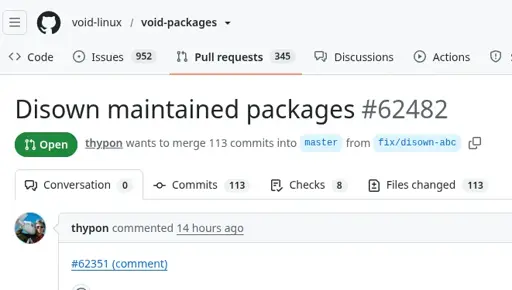
Cited from the article:
[…] the Void Linux project does have a contributing policy over AI usage that reads:
"In this section, “AI” refers to generative artificial intelligence tools, including Large Language Models and similar technologies.
All contributions are expected to be made by humans. AI tools may be used for research and learning, but all content in contributions must originate from and be understood by the contributor. This includes code, documentation, issues, security reports, pull request descriptions, and comments in all Void Linux community spaces.
ALL usage of AI tools MUST be disclosed.
Do not bring AI review tools into pull requests.
Usage of AI-powered human-language translation tools is acceptable to facilitate contributions across language barriers."
Some people do an astounding amount of work.
And then there are many, many, which help a little.
Also, if, say, somebody finds that in Debian testing is a malicious package, people which maintain Arch will learn that. Open information sharing between many thousands of people willing to coordinate is a superpower.
Oh god yeah, its just filtering through the slop that actually matters.
But like the XZ trojan that was only affecting Debian installs, each distro needs to individually have competent maintainers to ensure their store is safe.
If for exapmle I set a couple ‘bugfixes’ in the guix package file for emacs, I could reasonably infect a number of systems if a lazy maintainer just approved the request. (Or other attacks without even involving guix if I notied a bug in a package spelling and typo squatted it, or stole signing keys and pushed updates to the repo myself).
None of these would change anything to other distros maintainers, but because this distros AI maintainer could risk a large number of users devices.