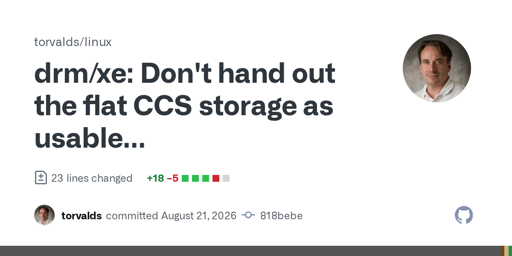
get_flat_ccs_offset() reads the base of the flat CCS storage from the
hardware, scales it by the number of enabled L3 nodes, and rounds the
result up to 128K. Everything below that offset is then ...
Both extremes are absolutely maddening here. I’m getting as sick of the anti-AI crowd as I am the vibe-code-tech-bros. At this point you could just put them all in a sack and start hitting them with sticks and wouldn’t care who got the worst of it.
There’s a definite middle-ground here. Linus is one of the ultimate pragmatists and it shows here. It was helpful - so he used it. It helped you so you used it. I’ve found it to be incredibly helpful so I use it.
Not all usages are equal just as all hand-written code is not equal. There are good ways to use these tools and bad ways. But the tools themselves are still just tools.
Yeah, it’s like a calculator. Don’t get reliant on it. Know why it gives an answer, be able to get to the answer yourself, but appreciate the time saving of the calculator when you can verify that it was correct much faster than getting to the answer yourself.
The art of using a digital calculator is being able to put in a problem that would take you a couple of minutes to solve, get the calculator’s answer in a couple of seconds, AND be able to spot-check the reasonable-ness of the answer in a couple of seconds more. Blind trust is ridiculously risky, cutting your speed by half to move from 99% correct to 99.99% correct is well worth the extra time and effort invested.


Both extremes are absolutely maddening here. I’m getting as sick of the anti-AI crowd as I am the vibe-code-tech-bros. At this point you could just put them all in a sack and start hitting them with sticks and wouldn’t care who got the worst of it.
There’s a definite middle-ground here. Linus is one of the ultimate pragmatists and it shows here. It was helpful - so he used it. It helped you so you used it. I’ve found it to be incredibly helpful so I use it.
Not all usages are equal just as all hand-written code is not equal. There are good ways to use these tools and bad ways. But the tools themselves are still just tools.
Yeah, it’s like a calculator. Don’t get reliant on it. Know why it gives an answer, be able to get to the answer yourself, but appreciate the time saving of the calculator when you can verify that it was correct much faster than getting to the answer yourself.
The art of using a digital calculator is being able to put in a problem that would take you a couple of minutes to solve, get the calculator’s answer in a couple of seconds, AND be able to spot-check the reasonable-ness of the answer in a couple of seconds more. Blind trust is ridiculously risky, cutting your speed by half to move from 99% correct to 99.99% correct is well worth the extra time and effort invested.
This isn’t such a simple question.
If you think about it that way, the atomic bomb is also a kind of tool, but not everyone is allowed to use it…
If a tool starts thinking for you, it’s clearly a different kind of tool than most known tools. Different tools have different safety procedures. :)
deleted by creator