

- cross-posted to:
- [email protected]
- cross-posted to:
- [email protected]
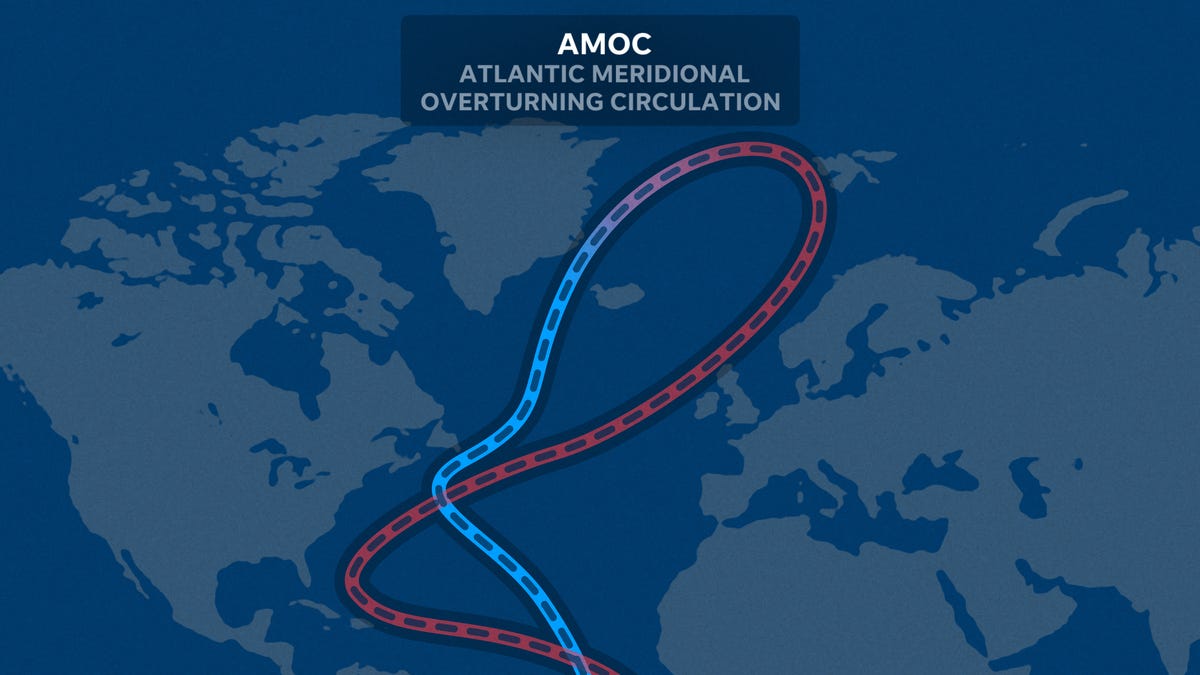
The potential collapse of a key Atlantic ocean current − due to human-caused climate change − is in the news again.
You’d be hard-pressed to come up with a scarier scenario than what’s going on now with the “Atlantic Meridional Overturning Circulation (AMOC),” the fickle Atlantic ocean current whose weakening and eventual collapse could change the climate and weather for hundreds of millions of people.
A pair of new scientific studies detail the present and potential future of the AMOC, which was the ocean current at the center of the fictional (and scientifically inaccurate) “Day After Tomorrow” climate change disaster movie in 2004.
In one study released April 8, scientists at the University of Miami determined that over the past 20 years, the AMOC has already been weakening at four different locations in the Atlantic. In the other study, released April 16, a separate group of European scientists said the AMOC will weaken by 50% by 2100, potentially eventually leading to its “collapse.”
A weakening AMOC means the Atlantic Ocean’s climate‑regulating currents slow down over a period of a few decades, while a collapse means the entire current system crosses a tipping point and mostly shuts down − triggering abrupt, potentially irreversible global climate disruptions.
Studies – https://www.science.org/doi/10.1126/sciadv.adx4298
Sorry, but why would we not use the name AMOC and instead call it the “22 year old movie current”?
What about “Aging Movie is Ominously Current” or AMOC for short?
Golf claps
Well done, old chap!
Another Menacing Ocean Con?
Probably because most people wouldn’t know what that acronym stood for.
I sure as hell don’t
Atlantic Meridional Overturning Circulation
Rolls right off the tongue.
deleted by creator
As a native English speaker, I concur with your feelings on the matter. I absolutely hate when someone does that and sometimes I won’t even bother to finish reading what someone wrote if they just start using acronyms all willy nilly. Hell, you can’t even point out spelling errors or grammar errors anymore without upsetting someone.
Sure, but “Atlantic” and/or “Ocean” were right there.
… It needs to have a title that Americans might actually read.
You know, half a football field, approximately 8 hamburgers, instead of actual measurements?
We’re on average 5th graders, as far as reading ability goes.
Last I saw it was 3rd grade. I would be hyped if it’s still at 5th
Down to 3rd grade?
The zombie apocalypse is progressing that rapidly?
For the clicks.
‘Scientist warn that environmental acronym is fucked’ is a headline everyone has learned to tune out.
But if maybe Jake Gyllenhaal can save us… I mean, now you want to know more, right?
I was really more thinking “Wait…what happened in that movie? Shit, when did I even watch that movie? Like 2007?”
The movie was based loosely on a ‘non-fiction’ book written by radio host and conspiracy theorist Art Bell.
So basically, that’s where we are currently with the state of discourse involving environmental science. We are being warned about something of massive significance and dire consequence by way of a reference to a 20 year old Roland Emmerich movie based on a book written by a loonie…
I’m not real hopeful for our chances as a species…
Oh don’t worry, I know all about Art Bell and his book ‘The Coming Global Superstorm.’
Still waiting on that “Quickening” he was talking about all those years ago.
I need a filter to eliminate any science article with quotes in the title