

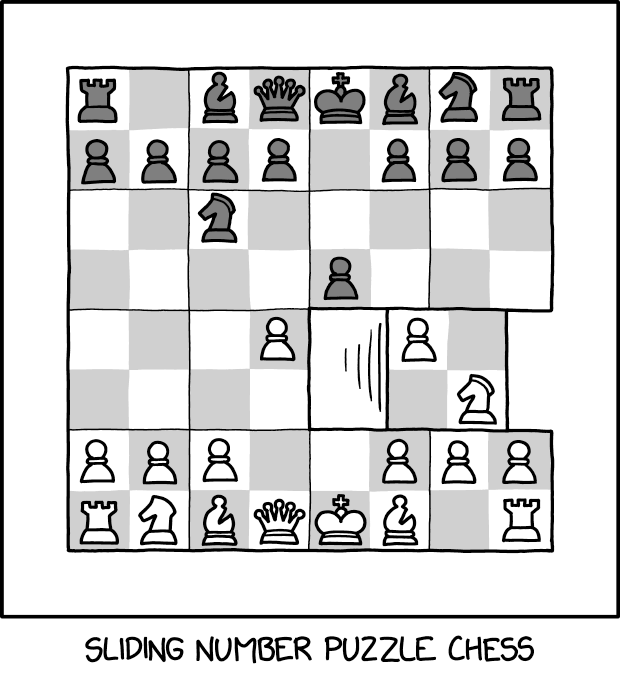
Alt text: The draw-by-repetition rule does a good job of keeping players from sliding a tile back and forth repeatedly, but the tiles definitely introduce some weird en passant and castling edge cases.
Alt text: The draw-by-repetition rule does a good job of keeping players from sliding a tile back and forth repeatedly, but the tiles definitely introduce some weird en passant and castling edge cases.
I’d say first you must do a slide, full slide no half slides. Then you must do a regular move. In that order.
And any missing spaces from the gap by the slide cannot be moved onto or over.
This way repeating the same slide still leaves the board in a different state.
Alternatively you might need to decide between sliding or moving. Often chess requires two turns to take a piece (you move a piece into attack range, opponent has a turn to react, and then you can take the piece). Being able to do two actions at once (slide tile and move a piece on the same turn) would allow you to take pieces that weren’t previously threatened. It would even allow you to position to take the enemy king, where you put him in check by sliding the board and then are able to take him on the following action.
Mhm, why limit to first slide then move? I agree with gap cannot be crossed.
Or first move then slide? Though I’m realizing what this means for check. So maybe either move or slide? Or if slide results in checking the opponent, you forfeit the move?
But if it’s either move or slide, then repeating slides to force a stalemate it a problem
Only if you don’t introduce a “repeating 3 slides? You lose” rule. Checkmate is the bigger issue imho.