It’s a pretty reductive take, that treats tools as politically and behaviorally inert. The work on understanding how cultural artifacts use us just as much as (or maybe more than) we use them goes back several centuries.
But Linus is just an engineer, after all. There’s no reason to treat him as some high-minded philosopher (and he’d probably be the first to tell you that). And for as long as the history of thought into the politics of artifacts may be, the history of engineers focusing only on solving the problem in front of them and not thinking about “where the rockets come down” is about as long.


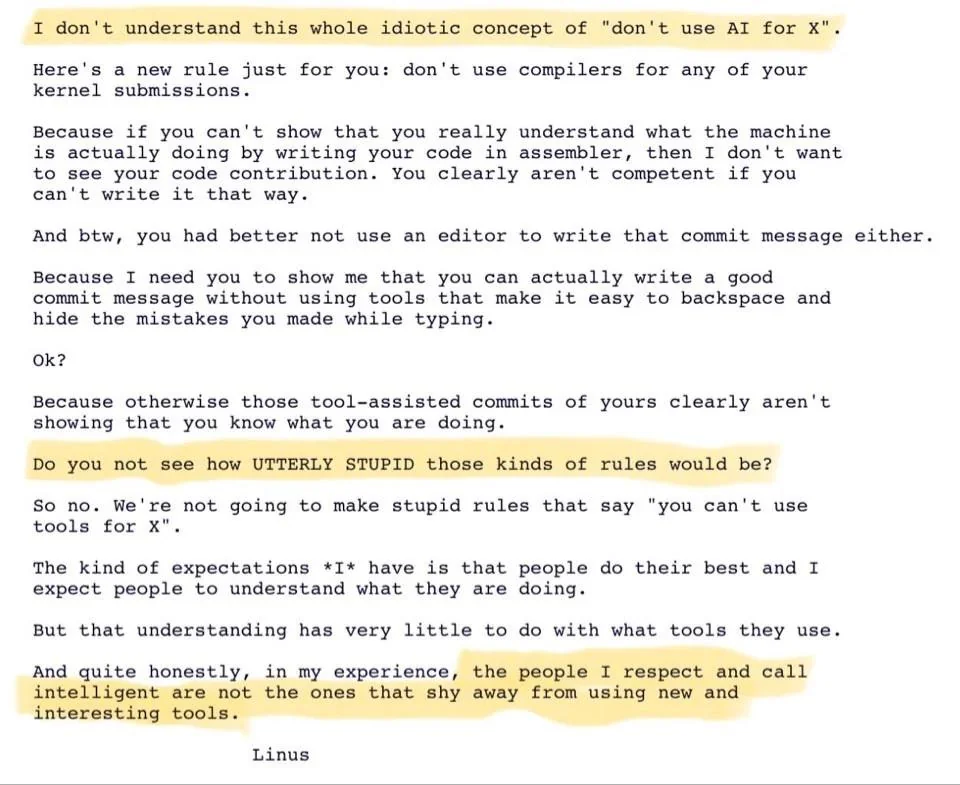
It’s a pretty reductive take, that treats tools as politically and behaviorally inert. The work on understanding how cultural artifacts use us just as much as (or maybe more than) we use them goes back several centuries.
But Linus is just an engineer, after all. There’s no reason to treat him as some high-minded philosopher (and he’d probably be the first to tell you that). And for as long as the history of thought into the politics of artifacts may be, the history of engineers focusing only on solving the problem in front of them and not thinking about “where the rockets come down” is about as long.