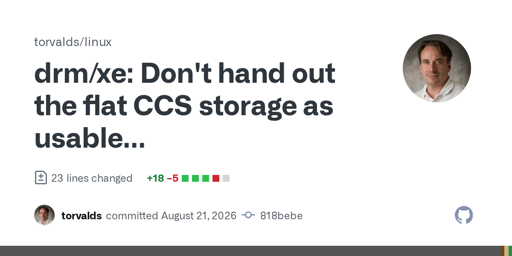
get_flat_ccs_offset() reads the base of the flat CCS storage from the
hardware, scales it by the number of enabled L3 nodes, and rounds the
result up to 128K. Everything below that offset is then ...
Honestly 15+ year old bugs are also left in the linux kernel for people to pick up, Learn from and get deeper in kernel development. They know they can easily find them with a LLM but choose not to. Policy’s are changing due to the mass influx of these “bug” fixes.
There’s academic exercises for education. The production kernel used by billions around the world is no place to intentionally leave bugs, and it doesn’t matter how they’re detected. What matters is if they are corrected without creating regressions.
Not really… “Education” and real world are vastly different. Getting accustomed to a mailing list other maintainers etc is not something you learn with your education.
And leaving bugs for hardware no one has touched in ages is not too big of a deal. And a nice gateway for new comers who actually want to learn it instead of trow a LLM at it.


Honestly 15+ year old bugs are also left in the linux kernel for people to pick up, Learn from and get deeper in kernel development. They know they can easily find them with a LLM but choose not to. Policy’s are changing due to the mass influx of these “bug” fixes.
There’s academic exercises for education. The production kernel used by billions around the world is no place to intentionally leave bugs, and it doesn’t matter how they’re detected. What matters is if they are corrected without creating regressions.
Not really… “Education” and real world are vastly different. Getting accustomed to a mailing list other maintainers etc is not something you learn with your education.
And leaving bugs for hardware no one has touched in ages is not too big of a deal. And a nice gateway for new comers who actually want to learn it instead of trow a LLM at it.
That’s in the Linux staging tree, where they have banned ai contribution for exactly that reason.
https://www.phoronix.com/news/Linux-Staging-Reject-LLMs