

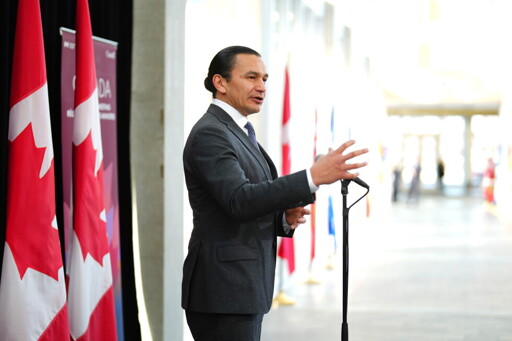
The premier of a Canadian province launched a blistering attack on U.S. President Donald Trump on Thursday, calling him a “bad person” and “not to be trusted” and urging Canada to keep fighting rather than rush to make concessions in trade talks with Washington.
Manitoba Premier Wab Kinew said Canada has leverage in the talks even as his province weighs restoring U.S. alcohol sales at Prime Minister Mark Carney’s urging to help secure a deal that would avert threatened 50% U.S. tariffs.
“Everybody knows the American president by now, he’s erratic, he’s irresponsible, and he’s not to be trusted. And this is the person that we were supposed to make a deal with, and we’re going to make additional concessions for it. That’s why I say you can’t make a good deal with a bad person, because who’s to say it’s not going to be undone?” Kinew said.
Hard agree, as someone who voted for Wab as my MLA. I wish he and Ford would stop fucking around and just let the federal government retain the jurisdiction over foreign affairs. Ford’s Reagan ad was factual and “felt good” for Canadians to see but really stirred the pot.
Trump is the one wiping his ass with NAFTA and now USMCA. They are not the ones stirring the pot. Anyway, provinces have a lot of say in who they trade with and if they want to make it hurt for states that violate trade agreements, then good for them.
I understand that Trump and the US are highly volatile and unreliable people unlikely to honor any agreement they make. That doesn’t mean we should make our negotiating team’s job harder by intentionally poking the wasp nest.
And no, provinces generally don’t have jurisdiction over foreign policy like trade agreements. That is a federal power, hence why its “CUSMA” (Canada-US-Mexico Agreement) not “BCASM…NFUSMA”. Provinces generally do not set their own foreign policy, and having emotions about Trump, the US, and threats to our sovereignty shouldn’t change that. At best provinces are allowed to make their own deals within the confines of existing frameworks set up by the federal government(s).
There is no concrete win from Wab totally owning MAGAts other than a cheap political stunt for Canadian audiences, and a concrete downside. See: Ford’s infamous Reagan ad and the fallout from that.
So you recognise that the US is unlikely to honor a deal, yet in the same breath ask not complicate negotiating the deal?
If the deal is a sham, why put any stock in it? Standing up for ourselves will only put us in a stronger postion down the road if the US ever becomes rational again. We’ll be just sitting there on the next administrations doorstep, with easy economic opportunity a signature away (and a list of demands).
Making a deal now is a fools errand. All Carney has to do is stem the bleeding to keep us afloat until then.
“It might rain later and ruin my sign I created for the parade later. No one really can predict the rain. I should piss on my sign because it doesn’t really matter anyways.”
A thoughtful approach to foreign policy.
It’s more like “Maybe I shouldn’t put a bunch of work into this sign, and reconsider attending the parade since the forcast is rain”.
I think people here don’t understand that I’m not advocating for capitulation. I’m saying “let the negotiation team manage the negotiations”, including deciding what pressures we’re applying and what we’re not willing to concede.
This is the political equivalent of going to buy a used car or something and bringing your kid along and the kid starts begging to buy the car. Wab and Ford are not party to these negotiations, and should not be undermining federal government’s negotiations.
I do agree with you on this, to an extent. I was very annoyed when D Smith flew down to Florida to usurp our bargaining power. However I do think the political environment has changed since then, and this isn’t anywhere near as bad.
It is within provincial jurisdiction - https://www.canada.ca/en/intergovernmental-affairs/services/internal-trade/canadian-free-trade-agreement.html
The CFTA aligns provinces with things like USMCA, but per my point, it’s being violated by Trump and some provinces are retaliating in ways that are still compatible with those agreements and are speaking up about it. As is their right.
Bud, what are you talking about? Per your own link:
This is a trade agreement between provinces and has nothing to do with foreign policy. Per the CFTA, Article 100 (Objective) and Article 101:
I’m wondering if you even read your own source? It’s free and online: https://www.cfta-alec.ca/cfta-agreement/chapter-one-initial-provisions
Like, have you ever heard of Manitoba (or any other province) setting import tariffs on US/foreign goods? No. When you import a good into Canada, does Manitoba CBSA charge you import fees? Do provinces even have their own CBSA? It is demonstrably false that provinces can set foreign trade policy without federal involvement and frameworks. They cannot tariff, set quotas, or even lower tariffs or import fees. They can buy and sell with foreign entities but only from within the confines of federal agreements like CUSMA, which is negotiated federally. Provinces can direct Crown Crops like liquor commissions to not buy goods made available via CUSMA, but they cannot change the terms of CUSMA to allow new goods, change import tariffs and fees, etc.
I’m actually losing my mind that you all are allowed to vote. I hope our nation increases our education budget for Canadian civics classes.
Constitution Act: https://laws-lois.justice.gc.ca/eng/const/page-4.html
Then, when Canada legally became distinct from the Empire, “The Parliament and Government of Canada” referenced here became the new, national government via the Statute of Westminster, and the jurisdiction for international Treaties and trade agreements was inherited by the federal government.
Read about it here: https://publications.gc.ca/Collection-R/LoPBdP/BP/prb0004-e.htm#A. Authority Respecting International Treaties(txt)
You people are so confidently wrong. Your downvotes mean nothing to me - I’ve seen what you upvote.
Fuck your “you people” superior bullshit. Like it or not we are all in the same melting pot together and different thoughts and ideas abound. The goal is to tighten up relationships and find common ground, not be disdainful/hateful. You cut yourself off from the herd just like an orange felon I know. Is that superiority? I may be wrong, but I’m confident about it. /s
“I’m wrong and proud!” is the most American thing I can think of. Enjoy.
“Wrong” and “Proud” transcend nationalism but I am having a joyful day regardless.