

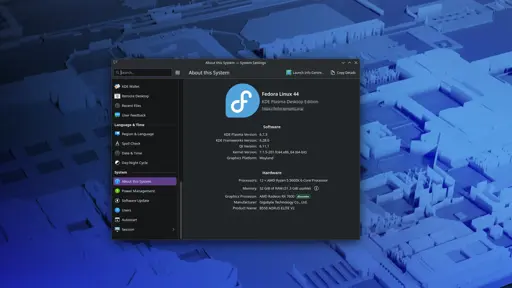
Two years into full-time Linux and I’m finally burning the distro-hopping cycle. I fell for the Arch/AUR trap for a while, but I got tired of spending my weekends debugging file manager crashes instead of maintaining my home lab.
Switched back to Fedora, and it’s boring in exactly the way I need it to be. It’s a stable launchpad for my projects, not the project itself.
I have been on this Linux jam since 1996 with a CD copy of Red Hat that came with a magazine (Byte, maybe?). In 2018 I made the jump to Debian based distros specifically because I got tired of the surprises. Now my lab runs LMDE. The only thing more stable and boring is Debian Stable itself.
Like you said, I want to focus on my projects, not have the OS be my project.
deleted by creator
That is strange.
deleted by creator
At the same time, Ubuntu is so dumbed down thst certain things are impossible via the UI. I spent a whole day and 5 reinstalls to be able to install an encrypted OS next to another partition. This used to be trivial though the infstaller.
Stable doesn’t necessarily means there aren’t any bugs, it just means it doesn’t change or changes are minor. Of course most bugs shouldn’t be a show stopper, though annoying they should have a way to bypass them or simply not have that great a impact.
I recall when using and regularly updating Arch, a library update borked a software dependent on it — a software required for a Uni class mind you — and while I managed to get it working afterwards, I had to stay awake through the night. That’s the difference between stable and rolling release, that wouldn’t happen as easily on Debian stable.
For most users a rolling release model is fine, for servers, it’s not.
Depends on what value of most “users” we are talking. Most users rarely stray outside the browser and I’d say rolling release with the risk of breakage it entails would not suit your average user very well at all.
Power users that are trying to eek out every drop of performance sure.
It’s a compromise. Of course you wouldn’t install a rolling release model OS on your grandma’s PC, but it can be necessary to have the latest drivers and software, and you don’t need to be a power user when the only thing you want is either compatible hardware or software. I concur that Arch is mostly for power users, though its derivatives don’t have to be.
I had Debian stable on my T480 for some time (maybe 3 years) and had no trouble at all. I was running XFCE at that time.
My first Linux distro was Red Hat 6 around 1996 I would suspect. It came with a Linux book that I bought.
I am pretty sure I started with either Halloween or Mother’s Day because Red Hat Linux for Dummies came with Red Hat 2.1 which I am pretty sure came out in 96 or 97. I know Red Hat 6 was released in 1999, because I was neck deep in Y2K work at the time I installed it on my Compaq laptop.
I found the O’Reilly Red Hat 6 book online and it came out in August 1999. I would have pegged it earlier than that but I guess not.