

Translation:
5, 10 or 15 percent? Card terminals are increasingly asking for tips.
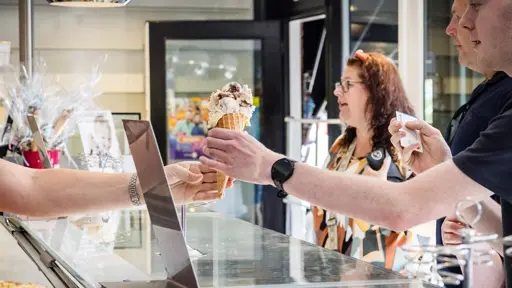
You may have had to do this lately too: choosing what percentage tip you want to give on the card terminal when paying in a restaurant or bar. Or clicking ‘no tip’ after all.
The number of hospitality businesses doing this is growing, and we are also tipping more often when we have to choose. This is evident from figures shared by payment companies with the NOS. When giving such a tip, we most often choose 5 percent from the options of 5, 10, 15 percent, or a self-chosen amount.
Hospitality businesses using payment and software company Tebi can decide for themselves whether to display the menu. It turns out that at coffee shops where you order at a counter, the percentage of tippers skyrockets when they ask for a tip. Almost no one adds a tip by card if no request is displayed, but with a request, that figure is over 20 percent.
In upscale restaurants, customers often leave a tip by card anyway, even if not asked. With a tipping menu, even more people do so, according to the figures. Percentage of transactions with a tip
At surf school and beach bar The Shore in Scheveningen, they have been working with percentage tips for quite some time. During the pandemic, the business switched to card payments only. “Tips dropped drastically then,” says co-owner Thomas Franse.
In 2021, The Shore got a POS system that had that tipping option, and it was enabled. “That was definitely the moment the tips went up again.”
Franse has mixed feelings about asking for tips. “It is not the best customer experience. In the beginning, we received quite a lot of negative reactions alongside the positive ones. However, it is an important source of income for the staff.” He also notices customers getting used to it now, because more and more hospitality businesses are doing it. A tip menu on a card reader
Payment company Adyen compiled data on the proportion of hospitality business owners who are customers of their establishments who use a custom tipping menu. For restaurants, this rose from 19 percent in the first half of 2025 to 22 percent in the first half of 2026. For bars and cafes, it rose from 46 to 53 percent.
“This indicates that this is increasingly becoming a standard part of modern payment processes in the hospitality industry,” says Julien Marlier, Benelux Manager. On card terminals where the tipping function is active, 61 percent choose ‘no tip’. Consequently, 39 percent do leave a tip, averaging 4.31 euros.
Tebi also has figures on the percentage we select when giving a tip. Most often, people choose 5 percent. “About a quarter enter their own, usually small, amount,” says general manager Florian Brunsting. “High ‘American’ tip amounts are hardly ever seen.” In the US, a tip of at least 20 percent is expected in restaurants. How much tip should we give?
The Irish pub Mick O’Connells in Utrecht also has card readers with tip requests. “It is sometimes quite surprising who does and doesn’t give a tip,” says manager James O’Halloran. “Young students, from whom you wouldn’t expect a tip, might give 5 or 10 percent. Wealthier bank employees sometimes give nothing at all.”
The tip is usually 5 percent, he notes as well. “On average, we receive about 3,500 to 4,000 euros in tips monthly. That is distributed entirely among employees, based on the number of working hours.” On average, it amounts to about 2 euros per hour. Less personal
Restaurant and bar patrons react differently to tip requests. “I didn’t give a tip,” says Sophie, who ordered at the counter at a salad bar in Utrecht and had to choose. “I find it less personal. It’s just: here, do you want to give a tip or not?”
“I like it because then I can choose for myself what, if anything, to give,” says a visitor to The Shore in Scheveningen. He gave a 5 percent tip. “People work hard for it. So it’s nice to give a little something extra.” More often in Amsterdam
Whether entrepreneurs opt for a tip menu varies by region. For instance, in Amsterdam, over 30 percent of Tebi customers have enabled the feature, whereas in Nijmegen, for example, it is only 10 percent.
During a survey in Den Bosch, several hospitality businesses said they did not want to get involved. “I’m not really a fan of it,” says Marc Bouman of Brasserij Breton. “I’m not going to push tips unnecessarily; people give it if they want to.”
“If you show that choice, people might feel forced,” says Angie Joosten of Café CinQ. “For us, it works just fine to leave it entirely up to each individual.”
To be fair, the system in question does the math for you. It is still contra to European tipping culture though.