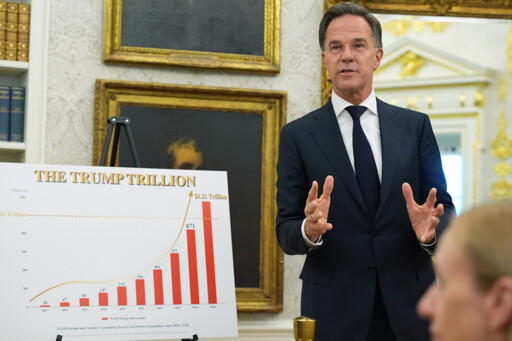
Since he started work as NATO secretary-general almost two years ago, Mark Rutte has spent much of his time trying to keep the United States anchored to the world’s biggest military alliance.
The issue is that the US provides a lot of logistics and supply chain support to the rest of NATO countries which makes it very difficult for them to operate without US support. It is made worse as many NATO nations are too small to meaningfully fill specialty units when they can barely provide basic infantry and armor units.
One of the reasons why France keeps pushing for an EU military is so that there is a government entity large enough to fund and pay for these specialty units. Otherwise, France would have to unfairly take on the burden of providing these capabilities itself.
Military satellites are almost entirely US right now, as well. There’s a gap in AWACS and similar as well, but it’s closing.
In theory, it should just be a matter of reorganising for the rest of NATO to do their own military logistics. We have the basic equipment and expertise needed.
The problem is that it doesn’t make sense for one country to bear the cost of developing those specialty items when you don’t have a country like the US who would do it on its own anyway. There is likely going to need to be a pooling of resources to fund the construction of these items. If you’re going to have to pool resources, what entity is going to be the best in receiving these resources and executing contacts to get these capabilities built?
Maybe you’re getting at the one big army concept, but it’s not really politically possible, at this point. In practice, it’ll be a smattering of the large nations, with cooperation from smaller nations. The French will probably be key for satellites in specific, because of Guyana.
It doesn’t have to be one big army, but it can be a big army designed to take care of the stuff that individual countries can’t. After all, it is unfair to put the financial burden to build out the expensive and necessary logistics on the large nations.


The issue is that the US provides a lot of logistics and supply chain support to the rest of NATO countries which makes it very difficult for them to operate without US support. It is made worse as many NATO nations are too small to meaningfully fill specialty units when they can barely provide basic infantry and armor units.
One of the reasons why France keeps pushing for an EU military is so that there is a government entity large enough to fund and pay for these specialty units. Otherwise, France would have to unfairly take on the burden of providing these capabilities itself.
Military satellites are almost entirely US right now, as well. There’s a gap in AWACS and similar as well, but it’s closing.
In theory, it should just be a matter of reorganising for the rest of NATO to do their own military logistics. We have the basic equipment and expertise needed.
There are gaps, but those gaps can be fixed. There’s a reason Saab are getting so many orders for GlobalEye.
The problem is that it doesn’t make sense for one country to bear the cost of developing those specialty items when you don’t have a country like the US who would do it on its own anyway. There is likely going to need to be a pooling of resources to fund the construction of these items. If you’re going to have to pool resources, what entity is going to be the best in receiving these resources and executing contacts to get these capabilities built?
Maybe you’re getting at the one big army concept, but it’s not really politically possible, at this point. In practice, it’ll be a smattering of the large nations, with cooperation from smaller nations. The French will probably be key for satellites in specific, because of Guyana.
It doesn’t have to be one big army, but it can be a big army designed to take care of the stuff that individual countries can’t. After all, it is unfair to put the financial burden to build out the expensive and necessary logistics on the large nations.