Interestingly, it’s about adhering to expectations more than anything else. If you have a road that seems to be fine to travel at a certain velocity and the speed limit is significantly lower, people will still speed and therefore create massive velocity differences between themselves and those obeying the law, causing dangerous circumstances.
For example, a highway has a posted speed limit of 25. Some will still attempt to use the road for the purpose that it was paved and posted, so now you have some driving 25 and others at near-highway speed. The difference in velocity is the issue.
The solution? Just paving, signing, painting, etc. correctly. Glad New Zealand found the proper signage
Driscoll was born in Ireland but living in Croydon, Surrey with her husband and children at the time of her death. She had planned a three-day trip to London to attend a League of the Cross festival. She was in the company of her teenage daughter May and her friend Elizabeth Murphy and was crossing Dolphin Terrace in the grounds of the Crystal Palace in London when she was struck by the driver of a car belonging to the Anglo-French Motor Carriage Company that was being used to give demonstration rides. One witness described the car as being driven at “a reckless pace, in fact, like a fire engine”.
Although the car’s maximum speed was 8 miles per hour (13 km/h), it had been limited deliberately to 4 miles per hour (6.4 km/h), the speed at which the driver, Arthur James Edsall of Upper Norwood, claimed to have been travelling. His passenger, Alice Standing of Forest Hill, alleged he modified the engine to allow the car to go faster, but another taxicab driver examined the car and said it was incapable of exceeding 4.5 miles per hour (7.2 km/h) because of a low-speed engine belt. The collision happened just a few weeks after a new act of parliament had increased the speed limit for cars to 14 miles per hour (23 km/h), from 2 miles per hour in towns and 4 miles per hour in the countryside.
It’s interesting how cultural speed expectations are. So back in 1896 a car going 4.5 miles per hour was really booking it - and I have no doubt it probably was a poor judgenent to reach such speeds considering the poor state of the roads with ample pedestrians and horse carriages going everywhere, lack of rules and training and because the roads were not at all optimized for car travel. But now that ‘reckless’ pace would get you causing an accident for the opposite reason.
Enforcement surely plays a part, too. If you know the speed limit and that you’ll be busted for sure for going a hair over in a particular stretch, then you’ll probably be on your best behavior. If it’s literally never enforced such that everyone is accustomed to going as fast as seems prudent to themselves, though…
This. Safest speed is the same speed as everyone else.
I was recently driving down a road that had its speed limit dropped from 100km/h to 60km/h. My wife just did 60, and I told her to speed up so she didn’t create a hazard.
30 seconds later, a local Commodore whips around us on a solid line on a windy road. It had a closing speed of about 30km/h. Everyone agreed it was quite dangerous, but she refused to accept that I was right.
I’ll add a pic. A country road in Victoria, Australia that had no set limit (read: default 100km/h) in 2018.
I find it a little funny that you were downvoted for understanding defensive driving. But I can understand why she would be uncomfortable driving any faster. That road looks thin
I drove a Yaris from Greymouth to Queenstown and it was a really good drive. The whole side of island had one road and it was empty. All the bridges are single-lane.


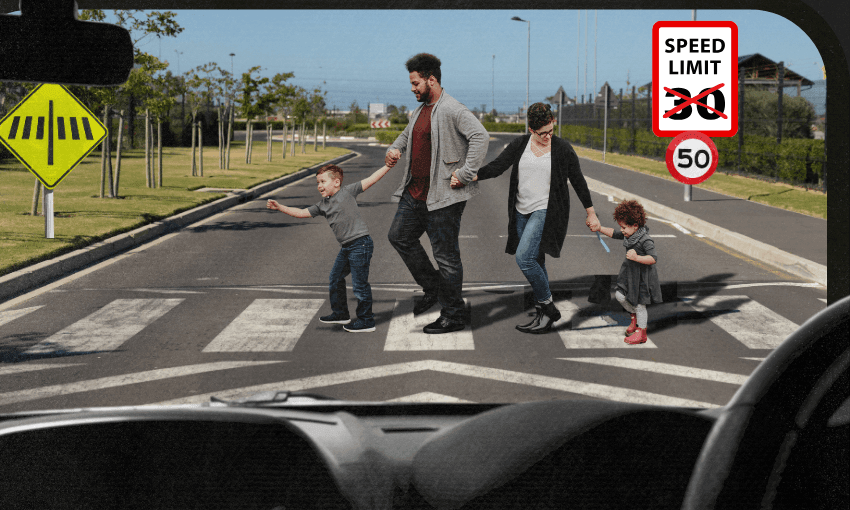
Interestingly, it’s about adhering to expectations more than anything else. If you have a road that seems to be fine to travel at a certain velocity and the speed limit is significantly lower, people will still speed and therefore create massive velocity differences between themselves and those obeying the law, causing dangerous circumstances.
For example, a highway has a posted speed limit of 25. Some will still attempt to use the road for the purpose that it was paved and posted, so now you have some driving 25 and others at near-highway speed. The difference in velocity is the issue.
The solution? Just paving, signing, painting, etc. correctly. Glad New Zealand found the proper signage
It’s interesting how cultural speed expectations are. So back in 1896 a car going 4.5 miles per hour was really booking it - and I have no doubt it probably was a poor judgenent to reach such speeds considering the poor state of the roads with ample pedestrians and horse carriages going everywhere, lack of rules and training and because the roads were not at all optimized for car travel. But now that ‘reckless’ pace would get you causing an accident for the opposite reason.
Enforcement surely plays a part, too. If you know the speed limit and that you’ll be busted for sure for going a hair over in a particular stretch, then you’ll probably be on your best behavior. If it’s literally never enforced such that everyone is accustomed to going as fast as seems prudent to themselves, though…
This. Safest speed is the same speed as everyone else.
I was recently driving down a road that had its speed limit dropped from 100km/h to 60km/h. My wife just did 60, and I told her to speed up so she didn’t create a hazard.
30 seconds later, a local Commodore whips around us on a solid line on a windy road. It had a closing speed of about 30km/h. Everyone agreed it was quite dangerous, but she refused to accept that I was right.
I’ll add a pic. A country road in Victoria, Australia that had no set limit (read: default 100km/h) in 2018.
I find it a little funny that you were downvoted for understanding defensive driving. But I can understand why she would be uncomfortable driving any faster. That road looks thin
She’s only scared of cops and cameras. Otherwise she’d be doing 110.
We have a lot of roads like that in NZ too, just barely two lanes wide. Locals will absolutely do 100 on them though.
I drove a Yaris from Greymouth to Queenstown and it was a really good drive. The whole side of island had one road and it was empty. All the bridges are single-lane.
Not one speed camera the whole way.
I’ve done that drive a few times now, it’s one of the most incredible parts of the country.
And yes, that’s a state highway, considered one of the country’s main arterial roads, and it has one lane bridges.
I’m with your wife. She was 100% correct. The criminal in the Commodore created the danger.