

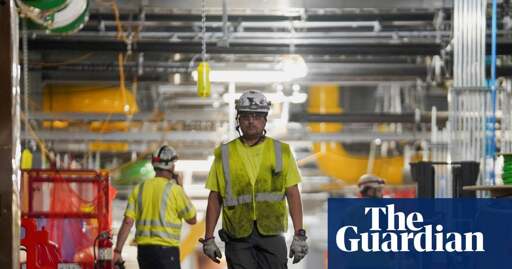
Microsoft and other US tech companies successfully lobbied the EU to hide the environmental toll of their datacentres, an investigation has found, with demands to block a database of green metrics from public view written almost word for word into EU rules.
The secrecy provision, which the European Commission added to its proposal almost verbatim after industry lobbying in 2024, hinders scrutiny of the pollution that individual datacentres emit. It leaves researchers with just national-level summaries of their energy footprints.
The rise of AI chatbots has spurred a boom in the construction of chip-filled warehouses with a hunger for power that is being met, in part, by burning fossil gas. Legal scholars warn the blanket confidentiality clause may fall foul of EU transparency rules and the Aarhus convention on public access to environmental information.
“In two decades, I cannot recall a comparable case,” said Prof Jerzy Jendrośka, who spent 19 years on the body overseeing the convention and teaches environmental law at the University of Opole in Poland. “This clearly seems not to be in line with the convention.”
If you are asking specifically about the EU, there lobbying rules in place for Parliament, Commission and Council. Lobbyists who want to enter their premise are required to register in a public list where among others the purpose of their lobbying, who they are lobbying for etc has to be recorded. Reputable big lobbying firms do that. But of course one can also do lobbying outside of those buildings.
Also, there is ar least some law enforcement happening. See the Quatar scandal in the European Parliament. While Quatar is openly bribing US authorities, without consequences, Quatar’s secret bribing of MPEs has led to MEPs losing their office and facing prosecution for corruption. The EU has also strengthened its own means for prosecution by establishing the European Public Prossecutor Office which is fully independent from the Commission unlike OLAF from which it took over this job.
All in all, control of lobbying is vastly insufficient but the EU is still doing more than many nonetheless.
Ok and they still need majority vote… often, at least? In which case there seem to be a lot of politicians who are just misinformed (if the lobbying has negative consequences), which doesn’t relate to lobbying specifically but their general decision making.
You always need a majority in Plenum but the people specialised on the topic arealso advising party colleagues. It is impossible to get into the details of every proposal. Therefore it depends a lot on how controversial a topic is. For high profile legislation MEPs in the plenum might have a closer look themselves and make up their own mind but on low profile stuff they might simply follow the recommendation of their own guy(s) in the comittee.
PS: Lobbying is not always bad and if it is bad depends also on what political views you have. NGOs and Unions are lobbyists as well. But in many cases lobbying is indeed bad, especially when lobbyists are trying to hide their true nature and their traces.
Ok makes sense, we then have basically indirect influence of the majority via trust in smaller groups of designated specialists.