

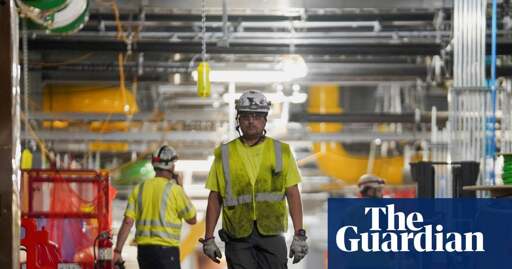
Microsoft and other US tech companies successfully lobbied the EU to hide the environmental toll of their datacentres, an investigation has found, with demands to block a database of green metrics from public view written almost word for word into EU rules.
The secrecy provision, which the European Commission added to its proposal almost verbatim after industry lobbying in 2024, hinders scrutiny of the pollution that individual datacentres emit. It leaves researchers with just national-level summaries of their energy footprints.
The rise of AI chatbots has spurred a boom in the construction of chip-filled warehouses with a hunger for power that is being met, in part, by burning fossil gas. Legal scholars warn the blanket confidentiality clause may fall foul of EU transparency rules and the Aarhus convention on public access to environmental information.
“In two decades, I cannot recall a comparable case,” said Prof Jerzy Jendrośka, who spent 19 years on the body overseeing the convention and teaches environmental law at the University of Opole in Poland. “This clearly seems not to be in line with the convention.”
because you need individual votes to make up any majority
So the lobbying is, in each particular instance, of potentially 100+ people (in the case of EU parliament 300 or so +), likely across parties? That seems difficult to organize, at first sight.
Lobbyists are people working on behalf of companies whose job is to meet up with politicians to discuss their issues. Typically that involves some back and forth that may or may not be considered bribery.
You want a law to protect your business? You go talk to lawmakers behind closed doors about how some laws are needed to better protect children and also data centers, and subtly let them know that maybe your company might have a job for them in the future.
Those lawmakers then go out and propose these laws and they sell the idea to other lawmakers who approve them for the children and datacenters.
So mostly not a consequence specifically of lobbying, if the majority votes due to actual conviction. Rather of disinformation/laziness, which will affect non-lobby initiated proposals too.
Lobbying on its own is not the issue. Nurses’ lobbies and teachers’ lobbies, for example, work for a good cause.
The issue is that lobbying is done in private, and citizens don’t hear about anything until laws are proposed, by which time they already have momentum and are very hard to fight. And once laws are enacted, it’s even harder to reverse them.
Yeah, it is indeed external influence which somewhat competes with democracy. What’s really bad is the reaching of consensus within the government via mostly trust in designated experts, instead of the voters individually studying the topic.