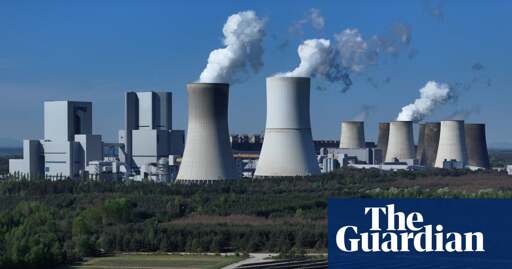
The argument for transitioning to renewables seems stronger than ever – and yet, attacks mount on the carbon price scheme that underpins the EU’s success at cutting pollution
I mean the industrial barriers to developing new nuclear energy are (AFAICT) similar to the industrial barriers to developing the production and Euro-sovereign supply chain for new battery solar and wind generation. Happy to be shown differently if you can point to me some differences that would have nuclear development require fewer physical resources, time or money.
I think some development in Small Modular Reactor tech is promising. Any in-progress or in-operation nuclear should stay the course. But if there was one technology we could choose to either ride fully into or vastly increase development alongside nuclear and other energy sources, the drastic cut in costs for renewables with battery storage seem to me like the silver bullet to the climate crisis everyone was waiting for, we just need our governments to pursue it NOW. In Italy’s particular case, tidal energy seems very suitable due to its massive coast relative to land size.
The main problem is that in europe there is no single regulatory body for the certification of nuclear reactor. That means that a nuclear reactor certified for france needs to be certified again for UK, Poland or Czechia.
The requirements for nuclear are much higher then a solar power plant. Each single material and part needs to be certified and the entire production is tracked (material traceability, QA testing, chain of custody). A valve in a nuclear power plant cost 100 times more then the same valve in a coal plant. There are very few companies that deal with this level of paperwork required, this means often you need to create new production lines.
Regulation in nuclear is not outcome oriented, but process oriented. So you do not have incentive to make everything more efficient: you do not care about the end result, you care about every single steps in the process. This make everything much longer and expensive. Post Fukushima raised a lot the cost of all design made before as new requirements caused to modify previous plants. This is one of the main reasons for the delay in nuclear deploy in the last 20 years.
So you’re arguing that the cost and regulation barriers are higher than renewable development. Are those increased costs proportional to the benefit to the higher baseload, and would an equivalent baseload not be able to be met through battery storage?
Yes, the barrier for nuclear is much much much higher then renewable development. We know that the same nuclear reactor costs 3.5 billion in china, 4.5 billion in japan, and 9 billion in Europe. That is a huge difference. This is not just a technology problem, but an issue about regulation and processes. I am not arguing for going back to the regulatory framework before Chernobyl and Fukushima, but to take some lessons from the world of aviation where safety is important, but outcome driven and pragmatic regarding costs.
If we want SNR to succeed we need to make it so that you certify one reactor out of the factory line and then you can build a hundred more without to having to re-certify every single reactor.
Battery can meet the equivalent baseload. The problem is production capacity, cost, connections and the pollution caused by this deployment. Often is simply better to deploy more renewable than needed. Today you need curtailment to manage grid stability, the higher the percentage of nuclear is the higher the dependency on battery and curtailment is raising the cost of renewable.


I mean the industrial barriers to developing new nuclear energy are (AFAICT) similar to the industrial barriers to developing the production and Euro-sovereign supply chain for new battery solar and wind generation. Happy to be shown differently if you can point to me some differences that would have nuclear development require fewer physical resources, time or money.
I think some development in Small Modular Reactor tech is promising. Any in-progress or in-operation nuclear should stay the course. But if there was one technology we could choose to either ride fully into or vastly increase development alongside nuclear and other energy sources, the drastic cut in costs for renewables with battery storage seem to me like the silver bullet to the climate crisis everyone was waiting for, we just need our governments to pursue it NOW. In Italy’s particular case, tidal energy seems very suitable due to its massive coast relative to land size.
The main problem is that in europe there is no single regulatory body for the certification of nuclear reactor. That means that a nuclear reactor certified for france needs to be certified again for UK, Poland or Czechia. The requirements for nuclear are much higher then a solar power plant. Each single material and part needs to be certified and the entire production is tracked (material traceability, QA testing, chain of custody). A valve in a nuclear power plant cost 100 times more then the same valve in a coal plant. There are very few companies that deal with this level of paperwork required, this means often you need to create new production lines. Regulation in nuclear is not outcome oriented, but process oriented. So you do not have incentive to make everything more efficient: you do not care about the end result, you care about every single steps in the process. This make everything much longer and expensive. Post Fukushima raised a lot the cost of all design made before as new requirements caused to modify previous plants. This is one of the main reasons for the delay in nuclear deploy in the last 20 years.
So you’re arguing that the cost and regulation barriers are higher than renewable development. Are those increased costs proportional to the benefit to the higher baseload, and would an equivalent baseload not be able to be met through battery storage?
Yes, the barrier for nuclear is much much much higher then renewable development. We know that the same nuclear reactor costs 3.5 billion in china, 4.5 billion in japan, and 9 billion in Europe. That is a huge difference. This is not just a technology problem, but an issue about regulation and processes. I am not arguing for going back to the regulatory framework before Chernobyl and Fukushima, but to take some lessons from the world of aviation where safety is important, but outcome driven and pragmatic regarding costs.
If we want SNR to succeed we need to make it so that you certify one reactor out of the factory line and then you can build a hundred more without to having to re-certify every single reactor.
Battery can meet the equivalent baseload. The problem is production capacity, cost, connections and the pollution caused by this deployment. Often is simply better to deploy more renewable than needed. Today you need curtailment to manage grid stability, the higher the percentage of nuclear is the higher the dependency on battery and curtailment is raising the cost of renewable.