

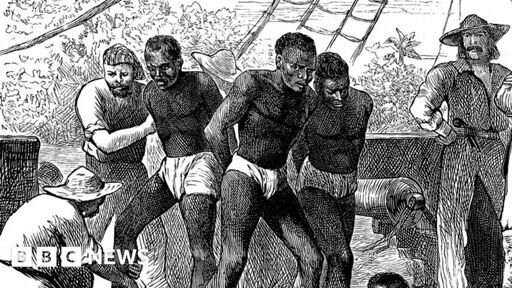
The United Nations General Assembly has voted to recognise the enslavement of Africans during the transatlantic slave trade as “the gravest crime against humanity”, a move advocates hope will pave the way for healing and justice.
The resolution - proposed by Ghana - called for this designation, while also urging UN member states to consider apologising for the slave trade and contributing to a reparations fund. It does not mention a specific amount of money.
The proposal was adopted with 123 votes in favour and three against - the United States, Israel and Argentina.
Countries like the UK have long rejected calls to pay reparations, saying today’s institutions cannot be held responsible for past wrongs.
I think this might miss the point of reparations
I thought the point of reparations is not to “pay off” a historical wrong, but instead is meant to help offset the generational of disadvantage caused by slavery and racism to those who suffer from that legacy today
we need all kinds of changes to end cycles of poverty and generational trauma, and reparations is just one tool among many to help with that - but it’s more about fixing the broken thing now than about absolving guilt
Well, sure. But a lot of developed nations already have a lot of programs aimed at doing that.
Also, as someone has said somewhere in this discussion, who exactly would receive reparations? It’s not exactly an easy thing to ascertain.
yes, I do think reparations has many problems with it - ideally it would be a matter of transitioning wealth accumulated through slavery from the people who benefited from slavery to the people who suffered under slavery. We are generations away on both sides, but it’s not like the effects haven’t certainly enriched some while hurting others even today.
Usually when I hear about reparations, the idea is to use tax money to do it, but at that point a lot of the people paying the taxes for reparations are also the victims of generations of slavery, so … I dunno, doesn’t feel like the most targeted or ethical approach.
And yes, who do we decide who receives reparations? Is it just for slavery, or are we going to recognize the way slavery and racism are intertwined and related?
What about reparations for other racist choices, like segregating Black communities and building interstates through their communities, polluting and robbing those communities of health, wealth, etc.?
Again, reparations is just one tool. I’m not sure you can really argue that racism has been properly dealt with or solved, or that reparations has no place in a program of racial and social justice, even if we can pick out logistical difficulties.
Further, why does it feel like you are against this project of justice, rather than for it?
I’m against reparations because, as you said, it would be unfair on both sides.
The people that would be taxed (the majority) probably never benefitted from it, at least not directly. I can give you an example. On my father’s side we made a family tree reaching all the way to the 17th century, and there were no rich landowners or noblemen. It’s highly unlikely they owned slaves. Should my family pay for reparations?
Now, if you can accurately trace slave owning people and their descendants are still wealthy, then by all means…
What I’m saying is it can’t be a blanket measure.
Also, if we europeans must pay, then the arabs better pay up as well.
And then you have the question of who receives the money. Africa is rife with corruption. I wouldn’t want the money to go to some corrupt government official. But how would you trace the exact people or families who should receive the money? What if the family who was enslaved mixed with the family/tribe/kingdom of the slavers? Then what?
I’m absolutely for helping Africa, but it just can’t be this fantasy notion of reparations because it’s not feasible.
Hm, my point wasn’t that reparations is unfair to both sides, but that there are better and worse ways to go about it.
Regardless, I think measures that aim to fix economic inequality and wealth distribution, and particularly efforts that are rooted in morally defensible arguments about repairing the harms caused by slavery and racism are noble and worthwhile. I’m even happy for imperfect versions of this where the US government pays reparations using tax money - it’s a much better use of my tax money (whether I personally benefited from slavery or not) than a lot of the villainous stuff the US currently does with my tax money.
Besides, the positive outcomes are alone worthwhile.
Typically I think of reparations as being sent to those who can show their lineage goes back to African slaves in the US, in which case it’s usually African-Americans who are the primary beneficiaries of reparations, not bureaucrats in Africa.
The way you are thinking about reparations makes me think you are not very keen on projects of social justice in general. Maybe you’re just jaded or cynical about the possibility for justice to be handled fairly, but I think we should be motivated to supporting and finding paths forward that help people whether they are perfect or not, and I just don’t get that vibe from you.
I am keen on social programs. Social welfare programs, which in fact I consider fundamental in a developed society.
I just don’t see reparations as a good social program.
They do have these programs but they barely scratch the surface or even contra the damage currently being done to the communities in question.
It’s not exactly easy but it’s not exactly impossible either. Of course, not you necessarily, someone could keep declaring it impossible to do no matter much the subject is researched.
For example, we can see that the communities effected by this have had far less investment than places that benefitted. The way to fix a severe lack of investment is through significant investment. There’ll be more, of course, but that’s an easy one right there.
I’m definitely not against giving more money in these programs, or widen their scope. I do think we have a moral obligation to help, in general. If you are better off, that is.
But where do reparations stop? There’s hardly a place on this planet who wasn’t taken advantage of, or hasn’t taken advantage of another.
I mean, we’ve barely started. I don’t think it’s time to think about when we should stop. But, if we have to, it’ll be when it’s finished.
Programs like “we bomb the shit out of you”, “climate catasthropy”, “unlimited global apartheid on the world’s exploited masses”?