

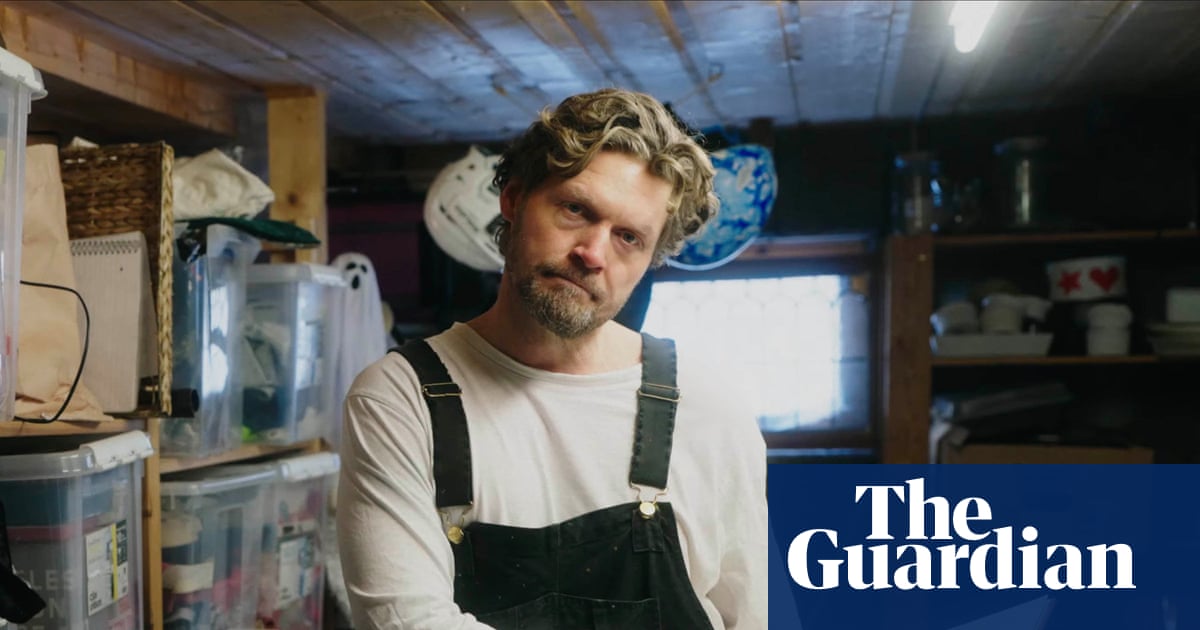
The video’s opening shot shows a man hiding under a bed snipping in a hole in someone’s sock. Seconds later, the same man uses a saw to shorten a table leg so that it wobbles during breakfast. “My job is to make things shitty,” the man explains. “The official title is enshittificator. What I do is I take things that are perfectly fine and I make them worse.”
The video, released recently by the Norwegian Consumer Council, is an absurdist take on a serious issue; it is part of a wider, global campaign aimed at fighting back against the “enshittification”, or gradual deterioration, of digital products and services.
“We wanted to show that you wouldn’t accept this in the analogue world,” said Finn Lützow-Holm Myrstad, the council’s director of digital policy. “But this is happening every day in our digital products and services, and we really think it doesn’t need to be that way.”
Coined by author Cory Doctorow, the term enshittification refers to the deliberate degradation of a service or product, particularly in the digital sphere. Examples abound, from social media feeds that have gradually become littered with adverts and scams to software updates that leave phones lagging and chatbots that supplant customer service agents.
Thank you too! I feel like a lot of times online discussions get derailed by tribal mentality, and that prevents both sides from understanding each other’s points, even when they might actually be similar. I think if we all focused on discussing our ideas without personal attacks or assumptions there would be a lot more intelligent dialogues, and while apparently not everyone agrees, it’s always nice when it does happen.
This is a valid reasoning, the issue is that mass media does its best to first convince you that there’s no issue, then that there’s an issue but the consequences aren’t that bad, then that the consequences are bad, but we can’t really do anything about it (the fact that Learned Helplessness is a named concept should be enough to tell how prevalent it is).
And even if someone manages to not fall for that and conceive a plan on how to change things, in a society where you have to work 40+ hours weekly for enough money to get by, how many people have the resources, time and willpower to work towards that plan?
I admit that my outlook might be too pessimistic, but I really feel like it’s going to be hard to correct course until there’s a very large amount of people in a situation so dire that they have nothing to lose. And while that could theoretically happen over time with the political landscape, I fear that for climate change we don’t have that much time.
You have me at a depressive phase, exhausted from my work week, so I fully agree with you. However, I know the more optimistic version of me would say:
But we overcame feudalism, we abolished slavery. These were also systems where the (incentives * power to change things) were strong and aligned to preserve the status quo. Still, our ancestors made the choices that made the world better for us, rather than for them. There must be a prosocial kernel in us, a drive we could appeal to if we could just broadcast a coordination signal loud and reliable enough.
I live in a remote town with a sizable population of city-raised, university-educated workers. I’m surrounded by people fully committed to both the liberal and conservative worldviews. Both groups have shitty individuals, exploiting the beliefs and biases of their faction for their personal advantage (the liberal ones tend to be smarter and more insidious, but all the worse for it; the conservatives dumber and more direct). But the majority of both groups are well-intentioned, caring people who would and do sacrifice for others. They’re just all convinced that fighting the mostly good people in the other faction is what’s right, rather than working together to change the game entirely. The challenge is to convince, to coordinate, not to defeat.
We overcame feudalism and abolished slavery in the strict sense of the terms, but did we really overcome the whole concepts or did they just shift to a more socially acceptable and insidious version of them? We do have what are commonly called “Technofeudalism” and “Wage Slavery”, and while they’re substantially better than the “original versions” for the “vassals” and “slaves”, the outcome for the ones benefiting from them are relatively the same: corporate giants can still get free money/services just by “renting” stuff they still have ownership on, and billionaires can pretty much “own slaves” from their perspective, since they get labor at a cost that is insignificant in relation to their net worth.
So, again the pessimist in me says, did we really get rid of those concepts with our own efforts or did most of the elites just “allow” us to do that after realizing it wouldn’t really be a problem for them (Mostly speaking about slavery, as quite a bit of time passed between feudalism and technofeudalism)? Will getting actually rid of those concepts be as “easy” as that? (Not that it was easy to get rid of slavery, but we did manage to do it in the end)
And most importantly, in the time since we abolished slavery we did gain more ways to organize across a country or across the world, but at the same time the ruling class gained mass media and social networks which are a MUCH more effective way of spreading propaganda than simple newspapers. What if that was the missing piece that ultimately allows them to make sure we can never get meaningful change going?
When something isn’t going well and we don’t think it’s our fault, the first instinct is to point the finger at someone else, and they know. That’s why the ruling class made sure that we keep pointing our fingers at each other so that the people pointing at them are never enough to consistently organize for change.