

cross-posted from : https://lemmy.zip/post/58909207
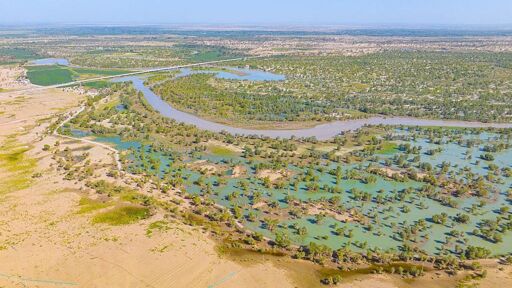
Mass tree planting in China is turning one of the world’s largest and driest deserts into a carbon sink, meaning it absorbs more carbon from the atmosphere than it emits, new research reveals.
“We found, for the first time, that human-led intervention can effectively enhance carbon sequestration in even the most extreme arid landscapes, demonstrating the potential to transform a desert into a carbon sink and halt desertification,” study co-author Yuk Yung, a professor of planetary science at Caltech and a senior research scientist in NASA’s Jet Propulsion Laboratory, told Live Science in an email.
My viewpoint: turning it into a carbon sink is likely true. A desert is near carbon neutral in its natural state anyway. Not much grows and not much decomposes. Adding even a bit of vegetation turns it into a carbon sink, but the number next to the minus sign will be very small, considering the total area.
Takla Makan is big (for those acquainted with Europe, about the size of Germany). Planting great numbers of bushes, shrubs and trees along the edges and the river beds will contain its shifting and spare settlements on the edges from the nuisance, but the desert remains a desert.
There is no need to confirm, they’ve published more than a bit about it. China has been working on containing the desert since 1978. A road was built across the desert more recently, in 1995, and a railway around it. They intend to drill a 11 km research hole to study the local region of the Earth’s crust. They intend to produce solar power.
Locals… well, this is Xinjiang. Locals mostly aren’t Han (ethnically Chinese) but various Turkic peoples, including the seriously repressed Uyghurs. They would probably fear a mass of Han Chinese moving in more than a mass of sand, but they are most likely OK with the trees, because sand pesters them just as badly. So far, it looks like not much is happening in that part of Xinjiang, because there is not much to build an economy on. Solar power is nice, but if sand buries it, it’s not so great. Currently, if you build a solar power plant to a random place in Takla Makan, there is a considerably above-zero chance of the desert burying it. Fencing it with lots of trees (irrigation needed) will allow a project to perhaps operate long enough.
For context the deepest hole ever drilled was 12km.