

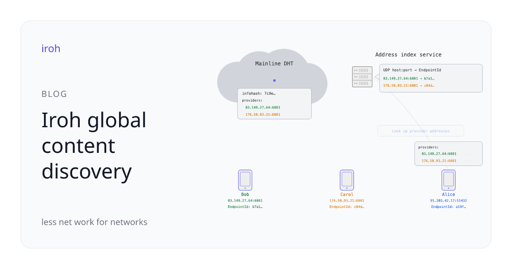
The new iroh-blobs design restores the initial “one unique identifier for each file” ethos of IPFS (abandonned by IPFS), to reduce swarm fragmentation. It takes the standard Blake3 hashing algorithm to generate file CIDs (equivalent to Bittorrent magnet infohash).
The protocol uses the Mainline Bittorrent DHT (not a custom DHT). There is no notion of block CIDs (no potential deduplication, but also less scalability issues for announcing each block CID on the DHT).
So that’s a lot of design simplifications that will improve implementation time.
If you are interested, have a try at Iroh-share, a CLI and TUI Rust implementation.
I can’t help but think about this while reading this post. However, this is probably indicative of my lack of understanding of computer networks, despite dealing with it from time to time.
Sorry for that! Basic is: it’s fully decentralized, and when anyone starts sharing a file, it joins a unique swarm of seeders. Whereas on Bittorrent, there is one swarm for each torrent, each private tracker for the same file, and also for folders (TV episode; TV season; TV series); this is called “swarm fragmentation” and leads to low speed and dead torrents.