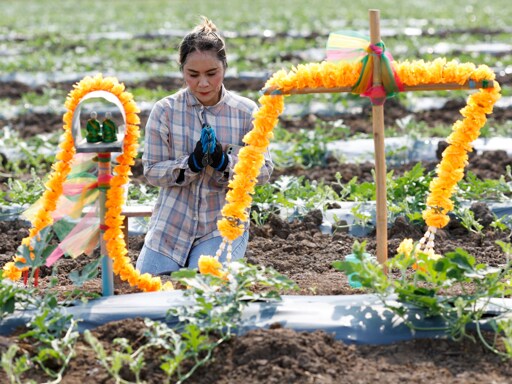
A prolonged disruption in the Strait of Hormuz could result in a global food “catastrophe”, the Food and Agriculture Organization (FAO) has warned, as shipments of critical agricultural inputs remain blocked in the key waterway due to the US-Israel war on Iran.
Food prices have not risen yet because existing stocks are absorbing the shock, the United Nations body’s chief economist, Maximo Torero, said in an interview on Monday, alongside David Laborde, director of FAO’s agrifood economics division.
But if traffic through the strait does not resume, the shocks to energy and fertiliser markets will translate into higher commodity and retail prices later this year and into 2027, Laborde added.
Exports of 20 to 45 percent of key agrifood inputs rely on sea passage through the Strait of Hormuz, according to the FAO.
“We will blockade the straight to pressure you into ending the war.”
“Omg agree to my unreasonable terms.”
“No.”
“Uhh okay now I blockade too.”
“Thanks for the help.”
Another reason to why we should be depaving and creating sustainable organic agriculture everywhere
“The efficiency and productivity of industrial agriculture hides the costs of depletion of soils, exploitation of groundwater, erosion, and extinction of biodiversity. Industrial agriculture uses 10 times more energy than it produces. It uses 10 times more water than biodiverse farming with water-prudent crops and organic practices use. In fact, when assessed from nature’s economy, biodiverse, ecological farms have much higher productivity than large-scale, industrial, monoculture farms. The illusion of efficiency is produced by externalizing the ecological costs.” / “…a polyculture [crop diversity] system can produce 100 units of food from 5 units of inputs, whereas an industrial system requires 300 units of input to produce the same 100 units. The 295 units of wasted inputs could have provided 5,900 units of food. This is a recipe for starving people, not for feeding them. A common argument used to promote industrial agriculture is that only it and industrial breeding can maintain the increased food productivity needed for a growing population. However, since resources, not labor, are the limiting actor in food production, it is resource productivity, not labor productivity, which is the relevant measure. What is needed is more efficient resource use so that the same resources can feed more people. A 66-fold decrease of food producing capacity in the context of resources use is not an efficient strategy for using limited land, water, and biodiversity to feed the world.” (from the book “Earth Democracy: Justice, Sustainability, And Peace” by Vandana Shiva)
This is just such a LARP man.
Not “could”, it has. The spring planting season is ending. The effect may not have shown up yet, but famine and recession are already baked in. Mostly in Africa and Asia.
Wheee, polycrisis is such a fun way to describe the modern world. Let’s just have every possible crisis all at once.
We’re crisismaxxing here, yo
The funny part is that the rich will keep eating at will